_97338.jpg)
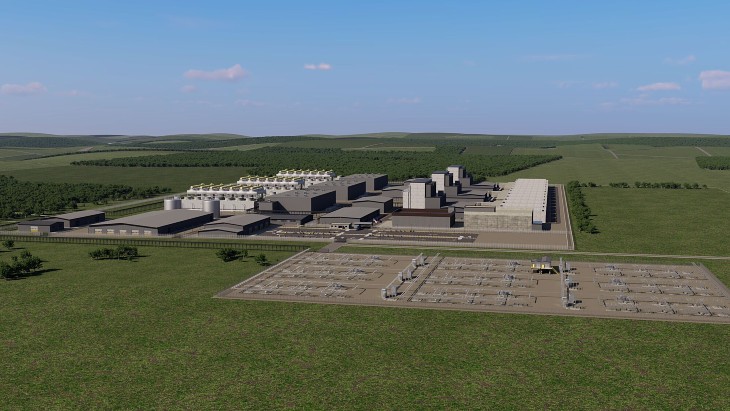
Athena is the reference architecture for Xcimer's planned fleet of fusion power plants. Designed for continuous operation, industrial scale, and a fuel cycle that renews itself, Athena integrates the company's proprietary excimer laser platform with target delivery, fusion chamber, tritium breeding, and power generation systems engineered from the outset for industrial scale.
Denver-based Xcimer's 724-page submission provided Department of Energy (DOE) reviewers with a detailed assessment of plant performance targets, economics, system-level engineering requirements, safety and environmental analyses, and technology development pathways required to achieve commercial fusion power.
"The question facing laser fusion is no longer whether the physics works," said Conner Galloway, CEO, Chief Science Officer, and co-founder of Xcimer Energy. "The question is how fast we can industrialise it. DOE's acceptance of Athena reflects both the strength of our technical approach and our ability to execute against an ambitious commercialisation roadmap."
Susana Reyes, Vice President for Chamber and Plant Design at Xcimer Energy, added: "A commercially attractive power plant looks very different from a scientific breakthrough facility. We are designing Athena to run continuously at a repetition rate of up to 1 Hz, and the use of a liquid wall chamber maximises availability by protecting the solid structures from the fusion reaction emissions over the entire plant lifetime.
"One reason other fusion chamber designs face a durability problem is that they put solid material where the fusion neutrons go. We don't. The molten salt curtain absorbs and moderates the flux, breeds fuel, and carries the heat - and it flows, so it renews itself continuously. We designed Athena around that property from day one, and it shapes everything: the materials choices, the thermal management, the maintenance philosophy, the economics. And Xcimer's laser architecture uniquely enables this design."
The DOE's acceptance of the Athena design follows Xcimer's completion of earlier programme milestones during the first 18-month budget period in the milestone programme. The company said its next phases of work include full-scale subsystem testing, engineering validation, and preparation for an integrated plant demonstration.
Xcimer published its roadmap to commercialising laser-inertial fusion in February this year.
"The milestone positions Xcimer among the front runners to commercialise fusion energy and marks one of the industry's most comprehensive government reviews of a privately developed fusion plant architecture," the company said. "The acceptance of both the design and roadmap also reflects continued progress under the DOE's Fusion Milestone Development Program and validates Xcimer's roadmap for translating laboratory fusion breakthroughs into a commercially deployable energy system."
Xcimer was one of eight companies selected by DOE in June 2023 to share USD46 million in funding from the Milestone-based Fusion Development Program, with the aim that "within five to 10 years" they "will resolve scientific and technological challenges to create designs for a fusion pilot plant". Xcimer said it had been awarded USD9 million.
Last week, Xcimer announced the launch of operations of its prototype laser system, code-named Phoenix – the largest privately owned laser system in the world and the company's prototype for commercialising laser fusion. Phoenix, housed in Xcimer's Denver laser facility, is a proof of concept for an unconventional fusion architecture: a krypton fluoride excimer laser using Stimulated Brillouin Scattering (SBS) to compress a microsecond-long pulse into the nanosecond timescales fusion requires. Phoenix is designed to demonstrate end-to-end integrated operation of excimer amplification and SBS pulse compression.


_80308_74311_79560.jpg)

_55605.jpg)