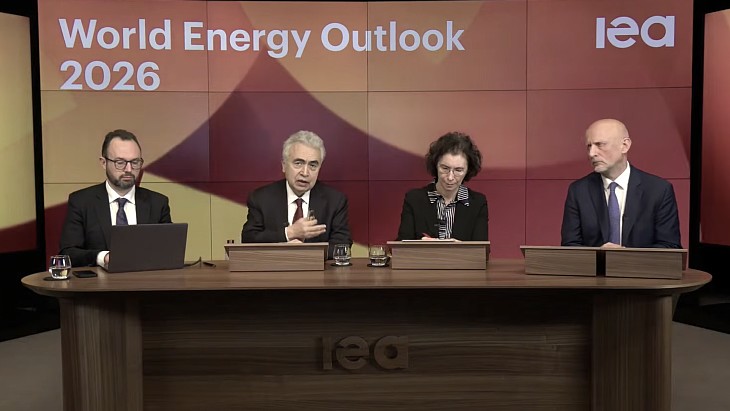
"This year's edition arrives at a moment of extraordinary uncertainty," the International Energy Agency (IEA) said. "It comes as the energy market impacts of the Middle East conflict and disruptions to shipping through the Strait of Hormuz have rippled out to all corners of the world. And this is taking place in a broader context of geopolitical strains, trade tensions, rising climate risks, cyberattacks and more."
The IEA says the global energy system has shown "considerable resilience" in the face of cumulative losses of 2.8 billion barrels of oil and 60 billion cubic metres of gas supply from the Gulf, but increasingly it is falling to consumers - and high prices - to absorb the impact as other buffers are run down. Responses to the crisis vary across countries, but there are some common themes: diversification of energy sources and suppliers; a stronger preference for domestically available resources; and a push for faster electrification. It says the biggest beneficiaries from a pivot towards domestic energy resources are set to be renewables - led by solar PV - and nuclear power, all of which see strong growth across the report's scenarios.
"In an echo of the 1970s, the 2026 crisis is set to reinforce the comeback of nuclear power," the IEA says. It notes that, as of mid-year, nearly 90 GW of new nuclear capacity was under construction - the highest level for more than 35 years, and more than 50 countries now have plans or targets for nuclear power, including new technologies such as small modular reactors.
"Nuclear power generation has been revised upwards compared with the World Energy Outlook 2025, with much of the upside in China and the United States," the IEA said. "Our projections now open up the prospect of nuclear power growing more rapidly than electricity demand, pointing to an increased share in the electricity mix from its current 9%."
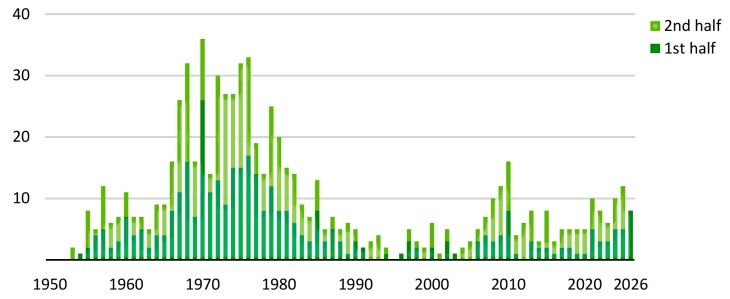
Number of nuclear reactor construction starts by calendar half-year, 1950-2026 (Image: IEA)
The World Energy Outlook 2026 considers the usual three exploratory scenarios. The Stated Policies Scenario provides an outlook based on the latest policy settings, including energy, climate and related industrial policies. The Current Policies Scenario considers a snapshot of policies and regulations that are already in place. The Net Zero Emissions by 2050 Scenario describes a pathway to reduce global energy-related carbon dioxide emissions to net-zero by 2050.
This year's World Energy Outlook also includes two new cases – the Additional Response Case and the Low Hormuz Case - that expand the IEA's analysis of the potential implications of the Middle East conflict beyond those captured in the exploratory scenarios. The Additional Response Case is grounded in supply and demand-side actions that are under consideration by governments, even if they are yet to be turned into formal policy proposals, while the Low Hormuz Case asks whether the energy world could manage without transit through the Strait.
Under the Current Policies Scenario scenario, global nuclear generating capacity increases from 420 GWe in 2024, to 583 GWe in 2035 and reaches 825 GWe in 2050 (compared with 728 GWe in 2050 in last year's edition), while in the Stated Policies Scenario capacity increases to 592 GW in 2035 and 886 GW in 2050 (728 GWe in 2050 in in last year's outlook). In the Net Zero Emissions by 2050 Scenario, nuclear capacity rises to 734 GW in 2035 and reaches 1,203 GW in 2050 (up from 1,079 GWe in 2050 in last year's edition).
"The current geopolitical and energy security environment could further boost nuclear power, which can diversify energy mixes and reduce exposure to market volatility while supporting reliability in increasingly electrified economies," World Energy Outlook 2026 says. "As part of the response to the 2026 energy crisis, many countries have confirmed or strengthened plans for nuclear power or extended the lifetimes of existing reactors, and some are reconsidering restrictions on nuclear development. In addition, new demand drivers, including electrification, AI and data centres, are strengthening the case for firm power sources such as nuclear."
IEA Executive Director Fatih Birol said: "The Hormuz crisis has delivered a huge shock to the system. While the energy sector and the global economy have shown considerable resilience, the longer the crisis lasts, the deeper the effects will be. And I don't see any credible pathway for the energy world to return to the way it was before.
"This World Energy Outlook looks past the current turmoil to explore the range of energy futures that could emerge from today's upheaval. By providing multiple scenarios – none of which are forecasts – and analysis of unparalleled scope, it can serve as a reference as countries consider their next steps. It also brings into focus the difficult trade-offs they face. In pursuit of greater energy security, countries must take care not to replace one dependency with another. But encouragingly for the future, energy security and energy transitions have never been so closely aligned."