The repository received its first waste shipment - 13 packages of waste totalling 47 cubic metres - in November 2016. It takes class 3 waste and class 4 waste such as, for example, clothing, air filters and packaging.
The repository is made up of reinforced concrete structures. The first phase, which opened in 2016, is 140 metres long, 24 metres wide and built at a depth of 7 metres. Together with the later phases, the repository can hold up to 55,000 cubic metres for up to 300 years. The walls of the storage structures, divided into cells, are more than half a metre thick and each cell is filled with special certified containers with 15-centimetre-thick concrete walls, which contain metal barrels containing pressed radioactive waste. After filling, each cell is concreted.
Once the waste is entombed, the facility was said at launch to be able to withstand a magnitude 6 earthquake. Once the site is fully loaded - which has been scheduled for subsequent decades - it will adopt the "green lawn" principle.
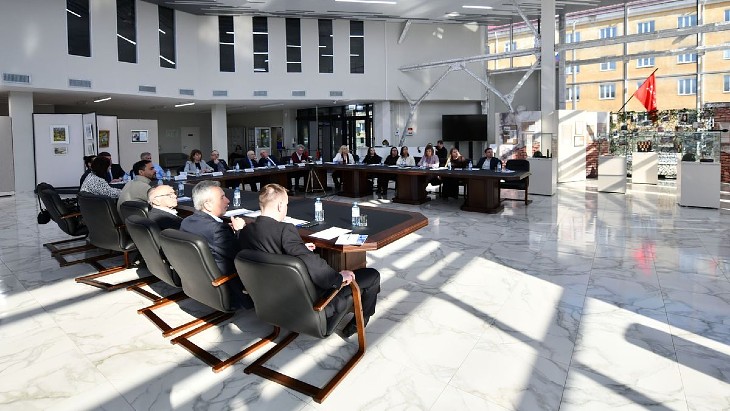
Vyacheslav Alexandrov, Director of the Ural Branch of the National Operator for Radioactive Waste Management (NO RAO), said: "An important result of our work is the accident-free and safe operation of the final isolation facility. We systematically conduct environmental monitoring and radiation control, and we share the results of these observations with the public. Throughout our operation, we have not recorded a single radiation incident. This speaks to the reliability of our facility's design solutions and, of course, is a testament to the high professionalism of our specialists."
Vasily Tinin, from Rosatom, said the facility had been created with a combination of domestic technologies and the world's best practices.
He said: "The facility plays an important role in meeting the needs of the nuclear industry and makes a significant contribution to achieving the national goal of transitioning from the accumulation of radioactive waste to reducing its storage volumes and eliminating the nuclear legacy. The experience of constructing and operating the facility in Novouralsk has laid a solid foundation for the further development of radioactive waste final disposal infrastructure in other regions where Rosatom State Corporation operates."
The National Operator for Radioactive Waste Management, part of state nuclear corporation Rosatom, also has two radioactive waste final disposal facilities under construction, in Seversk and Ozersk, with the first stages of these facilities scheduled to be commissioned in 2026. A separate underground research laboratory is being built as part of a project to create a deep final disposal facility for high-level radioactive waste in Krasnoyarsk Krai in Siberia.


_33441.jpg)
_17445.jpg)
_18654.jpg)