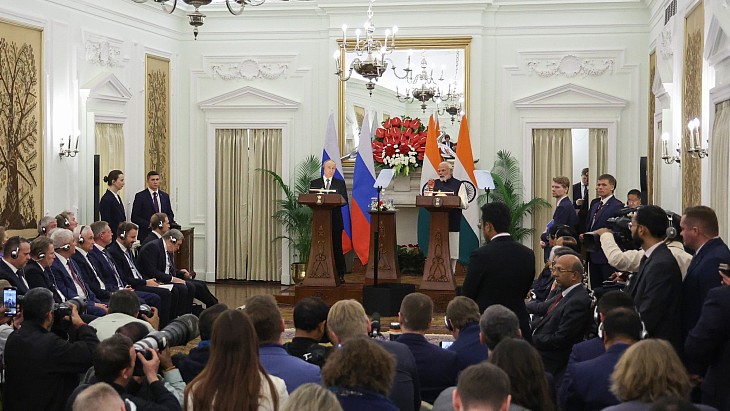
A joint statement issued by the Indian Prime Minister's Office after talks between Indian Prime Minister Narendra Modi and Russian President Vladimir Putin said the two sides: "Confirmed their intention to broaden cooperation in nuclear energy, including fuel cycle, life cycle support for operating Kudankulam Nuclear Power Plant and non-power applications, as well as to elaborate a new agenda of interaction in the field of peaceful use of atomic energy and related high technologies.
"The sides noted the importance of further discussion on the second site in India for an NPP; the Indian Side will strive to finalise formal allotment of the second site in accordance with earlier signed agreements.
"The sides agreed to accelerate technical and commercial discussions on the VVER of the Russian design, research and joint development of NPPs, localisation and joint manufacturing of nuclear equipment and fuel assemblies for Russian-designed large capacity NPPs, subject to terms and conditions as mutually agreeable."
In a joint press conference after the talks, Modi said that "enhancing connectivity between our two countries is a key priority for us" and said that they would move forward "with renewed energy" on transport links such as the Northern Sea Route, and the Chennai-Vladivostok route. The two sides also agreed on training Indian sailors on operating in Arctic waters.
Putin said that bilateral trade had reached about USD65 billion a year, and the aim was to increase that volume to USD100 billion. He also noted the progress on building the Kudankulam nuclear power plant and said that once it reaches full capacity "we believe that building small modular reactors and floating NPPs could also be relevant, just as using nuclear technology for non-energy purposes, including in healthcare, agriculture and other sectors".
He also said that Russia and India were collaborating on a project to "to create the North-South corridor linking Russia and Belarus to the Indian Ocean. Infrastructure development along the Trans-Arctic Transport Corridor, including the Northern Sea Route as its main artery, offers ample opportunities for expanding bilateral trade". The Northern Sea Route along Russia's northern coast relies on nuclear-powered ice-breakers for year-round navigation.
Rosatom Director General Alexei Likhachev said, according to the official Russian Tass news agency, that Rosatom and India's Ministry of Ports, Shipping and Waterways had established a working group to examine the potential for floating nuclear power plants in India. Russia has pioneered floating power units with the Akademik Lomonosov, which has been operating for more than five years. Russia's designs use modified versions of the small reactors used for the nuclear-powered ice breakers.
Background
The Kudankulam site, about 100 kilometres from the port city of Tuticorin at the southern tip of India, is already home to two operating Russian VVER-1000 pressurised water reactors which have been in commercial operation since 2014 (Kudankulam unit 1) and 2017 (unit 2). Four more are currently under construction, in two phases: construction of units 3 and 4 began in 2017, with work on units 5 and 6 beginning in 2021. Two further units - Kudankulam 7 and 8, larger AES-2006 units with VVER-1200 reactors - have been proposed as a fourth phase of the plant.
Last week, the first delivery took place of nuclear fuel for the initial loading of Kudankulam unit 3.
According to World Nuclear Association information, India currently has 24 operable nuclear reactors totalling 7,943 MW of capacity, with six reactors - 4,768 MW - under construction. (The Indian government often classes two units at Gorakhpur where site works have begun as being under construction, although the first concrete for the reactor buildings has not yet been poured.) A further 10 units - some 7 GW of capacity - are in pre-project stages.
India has a target to expand its nuclear energy capacity to 100 GW by 2047. It plans to achieve this by a two-pronged approach, with the deployment of large-capacity reactors as well as small modular reactors (SMRs). In August Minister of State Jitendra Singh outlined to the country's Parliament the three types of SMR that are being designed and developed by the Bhabha Atomic Research Centre for demonstration: the 200 MWe Bharat Small Modular Reactor (sometimes referred to as BSMR-200); a 55 MWe small modular reactor (SMR); and a 5 MWt high temperature gas cooled reactor for hydrogen production by coupling with suitable thermochemical process for hydrogen production.


_98552.jpg)
_1_12560.jpg)
_22582.jpg)


_84289_33276.jpg)