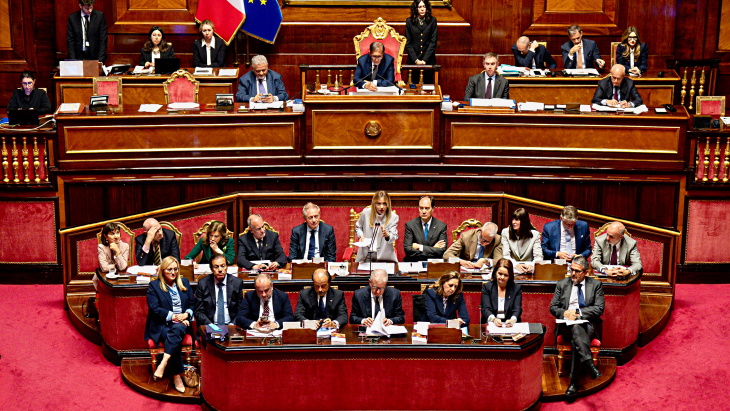
Responding to a question on the establishment of a control board to address the country's strategic priorities, she told the Senate: "I believe your question raises a common ground, which is clearly the current situation we find ourselves in: the particularly complex international economic environment and the ongoing geopolitical tensions we are experiencing will impact, as they are already impacting, growth, energy costs, business competitiveness, and household purchasing power. And that, in these challenging times, there should be less room for controversy and more room for concrete discussion on the major strategic issues affecting Italy.
"Clearly, among these major issues, there's energy. You know that the government - whether you agree or not - has been working on this from the beginning, from the gas release to the nuclear measures. I'd also like to take this opportunity to point out that the enabling law will be approved by the summer, and the implementing decrees will be adopted to create the legal framework necessary for the resumption of nuclear power in Italy."
In October last year, Italy's Council of Ministers, at a meeting chaired by Meloni, approved for final consideration a bill delegating responsibility for the reintroduction of nuclear energy in the country to the government. The bill empowers the government to comprehensively regulate the introduction of 'sustainable' nuclear power, within the framework of European decarbonisation policies by 2050 and energy security objectives. The mandate includes, among other things, the development of a National Programme for Sustainable Nuclear Power, the establishment of an independent Nuclear Safety Authority, the strengthening of scientific and industrial research, the development of new skills, and the implementation of information and awareness campaigns.
The implementing legislative decrees must be adopted within 12 months of the law's entry into force.
Italy operated a total of four nuclear power plants starting in the early 1960s but decided to phase out nuclear power in a referendum that followed the 1986 Chernobyl accident. It closed its last two operating plants, Caorso and Trino Vercellese, in 1990.
In late March 2011, following the Fukushima Daiichi accident, the Italian government approved a moratorium of at least one year on construction of nuclear power plants in the country, which had been looking to restart its long-abandoned nuclear programme. In a poll held in June of that year, 94% of voters rejected the construction of any new nuclear reactors in Italy. However, a poll conducted in June 2021 showed that one-third of Italians were in favour of reconsidering the use of nuclear energy in the country, with more than half of respondents saying they would not exclude the future use of new advanced nuclear technologies.
In May 2023, the Italian Parliament approved a motion to urge the government to consider incorporating nuclear power into the country's energy mix. In the September of that year, the first meeting was held of the National Platform for Sustainable Nuclear Power, set up by the government to define a time frame for the possible resumption of nuclear energy in Italy and identify opportunities for the country's industrial chain already operating in the sector.


_51287.jpg)