_96680.jpg)
The 20-year power purchase agreement announced by Google and Constellation Energy will enable investments in new equipment and technology at 11 Constellation-owned nuclear units in Illinois, Pennsylvania, and New Jersey, the companies said. The improvements in thermal and electrical efficiency achieved will result in adding new capacity to the grid, expanding total electricity generation available across the PJM footprint. The agreement helps sustain roughly 4,400 existing jobs, creates approximately 7,200 new construction jobs during the building period and represents more than USD4.3 billion of new investment by Constellation, the company said.
The 890 MW of incremental capacity delivered through this collaboration equals the output of three or more small modular reactors (SMRs) or a large new conventional reactor.
The companies have also entered into a 15-year energy supply agreement for an additional 2,700 MW in PJM's fleet, which Constellation says will provide revenue certainty, ensuring existing assets remain economically viable without taking resources off the grid.
Google and Constellation have also agreed on a strategic framework to evaluate opportunities to develop new clean generation, storage and demand response across the USA to support Google's growth, prioritising near-term efforts in the PJM region. Constellation has selected Google Cloud and Gemini Enterprise under an expanded five-year technology alliance which aims to use AI to reduce the costs of new infrastructure, improve performance, ensure enough power is generated to meet rising demand, and safeguard the energy grid.
Nuclear uprates can be achieved through measures such as modernising and upgrading turbines, steam generators, and digital control systems at operating plants. This can deliver substantial capacity gains without the multi-year timelines or interconnection bottlenecks associated with greenfield construction, providing a practical, near-term mechanism to deploy firm, clean megawatts to meet increasing electricity demand, Constellation said.
The 890 MW of incremental capacity that will be delivered through the collaboration is equivalent to the output of several small modular reactors or a large new conventional reactor. The initiative directly advances the goals of the US government's UPRISE programme to maximise electricity output from existing nuclear infrastructure through public-private collaboration, the companies said. The first uprate is expected to be delivered by 2028.
"We're committed to meeting our growth responsibly by actively investing in clean, reliable power that brings new capacity to our nation's grids," said Amanda Peterson Corio, global head of energy and power at Google. "Our agreement with Constellation to fund nuclear reactor uprates will strengthen the PJM grid, which serves 67 million people, all while protecting energy affordability and supporting local union jobs."
"Preserving and expanding the output of the existing nuclear fleet and developing new clean generation is critical to meeting our nation's growing energy needs while keeping costs affordable for homes and businesses," Constellation Chairman, President and CEO Joe Dominguez said. "This long-term clean energy collaboration with Google can serve as a model for how technology companies and the energy industry can work together to responsibly develop the digital economy and invest in our nation's energy infrastructure in a way that delivers grid-wide benefits for all, funded by private entities."
The announcement comes days after Constellation's 20-year power purchase agreement with tech giant Amazon, enabling it to add 190 MW of capacity and extend the operating life of the Calvert Cliffs nuclear power plant in Maryland.
Google has recently signed an agreement to support uprates on Georgia Power's share of the Vogtle and Hatch plants, adding around 96 MW of new capacity to the grid. The tech giant also recently signed a long-term power purchase agreement with Finland's Fortum covering up to 50% of the Loviisa nuclear power plant's capacity and providing financial certainty for power uprates and lifetime extensions until 2050. And an October 2025 agreement with Google is underpinning the planned restart of NextEra Energy's Duane Arnold nuclear power plant in Iowa.
Wisconsin agreement
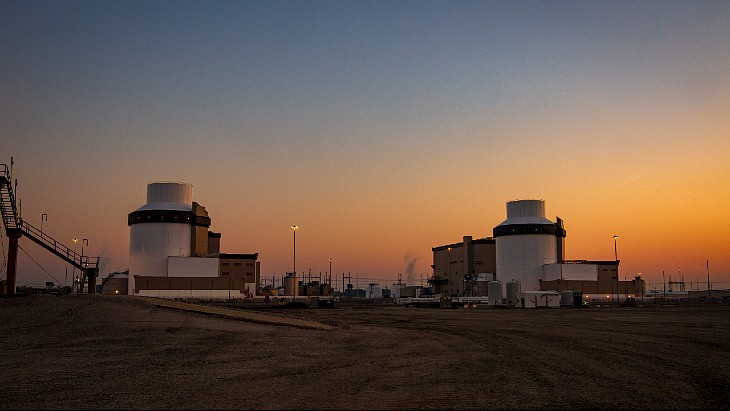
Separately, on 2 October, database and cloud infrastructure company Oracle announced a commitment to subscribe to a portion of the electricity generated by the existing Point Beach nuclear power plant. NextEra Energy's twin-unit pressurised water reactor plant sits on the shore of Lake Michigan, near the city of Two Rivers, Wisconsin. The first unit began commercial operation in 1970, and the second in 1973.
Oracle said the subscription, which is subject to approval by the Public Service Commission of Wiscon, will help shield customers from the plant's rising costs, reduce pressure on household electricity bills, and sustain reliable power for the Wisconsin grid.
"Oracle is stepping up with a commitment that will directly benefit more than one million Wisconsin utility customers," said Mahesh Thiagarajan, executive vice president of Oracle Cloud Infrastructure. "By absorbing approximately USD300 million in rising energy costs, we are helping protect Wisconsin ratepayers while supporting the reliable, carbon-free power the state depends on. This is a meaningful investment in Wisconsin's future - and in the communities we are proud to serve."
The planned commitment builds on Oracle's broader investment in Wisconsin through its Project Lighthouse data centre development in Port Washington, which is expected to generate more than USD11 billion for the local economy, create more than 4,000 skilled construction jobs over three years, support 1,000 ongoing operations positions, launch workforce development programmes, and invest in local infrastructure. In addition, Oracle said it will fully fund Project Lighthouse's energy costs to protect ratepayers' electricity bills and support grid reliability.
The announcements are the latest in a series of power purchase deals and other investments in nuclear energy by tech giants and other end users, who need reliable 24/7 low-carbon power for things like data centres.


_51287.jpg)
_82983_12913.jpg)