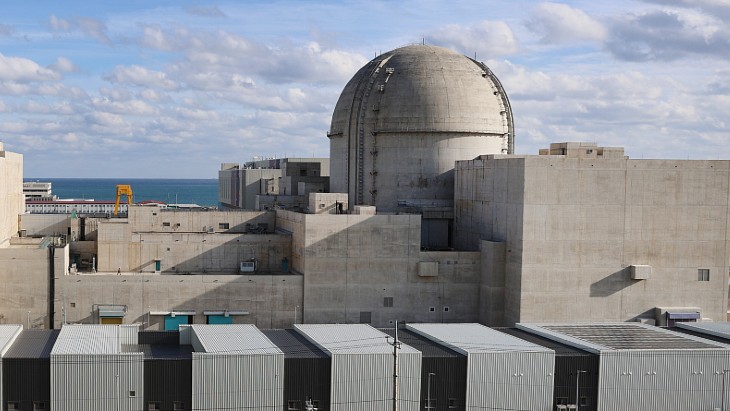
The unit, formerly known as Shin Kori Unit 5, is an APR1400 pressurised water reactor with an output of 1,400 MW and a 60-year design life.
Korea Hydro & Nuclear Power (KHNP) said it now plans to begin fuel loading, followed by approximately eight months of performance testing, including power ramp-up testing and maintenance, with the goal of commercial operation in August.
KHNP received the original construction licence for the unit in 2016 and began work. It applied for an operating permit in August 2020.
Progress on the unit has been affected by South Korea's previous nuclear phase-out policy.
The new unit has a number of enhanced safety features, such as a 15 centimetre increase in the reactor building's wall thickness - and a 30cm increase in auxiliary building wall thicknesses - to withstand external events, such as an aircraft crash. There are also additional measures to protect against earthquakes and backup generators in case of a loss of external power. It also has storage capacity for used nuclear fuel for its entire 60-year design life.
Acting KHNP President and CEO Jeon Dae-wook said: "We will thoroughly conduct test runs and inspections, prioritising safety and quality assurance, to ensure that Saeul Unit 3 can produce electricity stably."
Nuclear Safety and Security Commission Chairman Choi Won-ho said: "We have thoroughly verified the safety of Saeul Unit 3 based on procedures stipulated by law and scientific and technological evidence, and we plan to thoroughly confirm safety through pre-use inspections during the nuclear fuel loading and test run that will be carried out after the operating licence is issued."
KHNP said the Saeul Unit 3 construction project involved approximately 760 companies and had not only created jobs but also generated production in related industries, including equipment manufacturing, construction and maintenance. And it said the unit would continue creating jobs directly and indirectly over its 60-year operational period.
Once commercially operational, it will supply approximately 1.7% of Korea's total power generation and 37% of Ulsan's electricity demand.
In 2022 KHNP announced that units 3-6 of the Shin Kori plant in Busan in southeastern South Korea would be known as units 1-4 of the Saeul plant. The names of Shin Kori units 1 and 2 - two OPR-1000 reactors that began operating in 2011 and 2012, respectively - remained unchanged.
South Korea is among the world's most prominent nuclear energy countries with 26 operable reactors generating about a third of the country's electricity. Nuclear energy has been seen as a strategic priority for the country, but President Moon Jae-in, elected in 2017, introduced a policy to phase out nuclear energy over 45 years. This policy was scrapped in 2022 by then-President Yoon Suk-yeol.
South Korea has four operational APR1400 units - Saeul units 1 and 2 (formerly Shin Kori 3 and 4) and Shin Hanul units 1 and 2, plus the APR1400s under construction as Saeul units 3 and 4. Four APR1400 units have also been built at the Barakah nuclear power plant in the UAE, which are all now in commercial operation.


_55605.jpg)