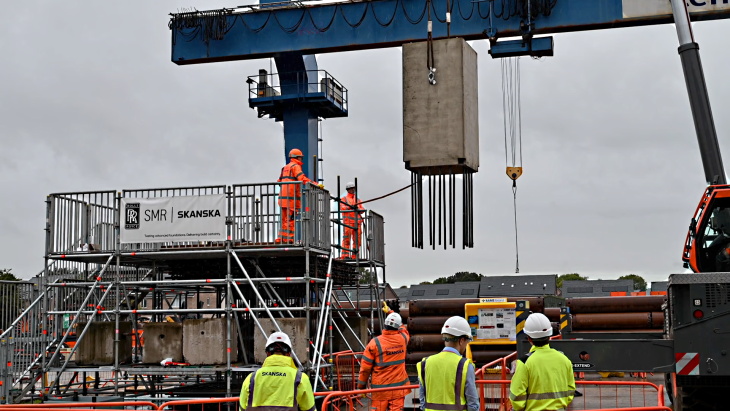
Rolls-Royce SMR contracted Skanska UK - a subsidiary of Sweden's Skanska - in January this year to deliver an aseismic bearing pedestal demonstrator for its small modular reactor (SMR).
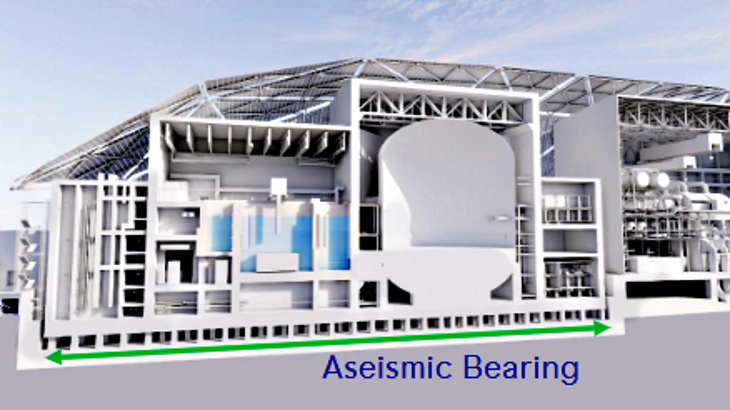
Aseismic bearings are installed beneath the plant's nuclear island to decouple the reactor building from ground motion during an earthquake. By absorbing and dissipating seismic energy, they reduce the forces transmitted to the superstructure, preserving both integrity and functionality.
Skanska said the demonstrator - constructed and trialled at its Bentley Works facility in Doncaster, England - has successfully proven the approach to producing the first-of-its-kind precast bearing pedestal off site.
"The successful completion of this demonstrator marks an important step in developing a factory-built approach to delivering our SMRs," said Ruth Todd, Operations and Supply Chain Director, Rolls-Royce SMR. "Our delivery programme is ramping up. By testing and refining critical components ahead of deployment, we can reduce risk, improve predictability and strengthen confidence in our fleet delivery model. The project also highlights the value of early collaboration with our supply chain partners, bringing together expertise from across manufacturing, engineering and construction as we industrialise the delivery of nuclear power plants."
Terry Muckian, Executive Vice President, Skanska UK, said: "Successfully completing this demonstrator is an important achievement for both teams. It shows the value of collaboration in testing and proving the construction approach before moving into delivery. By combining our civil engineering, design, steelwork manufacturing and off-site construction expertise, we have demonstrated how this critical component can be produced in a controlled factory environment. We are proud to be working with Rolls-Royce SMR and to be able to bring Skanska's experience and expertise to the next generation of nuclear energy."
(Image: Rolls-Royce SMR)
The demonstrator forms part of Rolls-Royce SMR's approach to testing and proving construction methods before they are deployed on future power plants. Manufacturing elements away from the final construction site has the potential to provide greater control over production, quality and sequencing, while helping to make construction more predictable.
The Rolls-Royce SMR is a 470 MWe design based on a small pressurised water reactor. It will provide consistent baseload generation for at least 60 years. Ninety percent of the SMR - measuring about 16 metres by 4 metres - will be built in factory conditions, limiting activity on-site primarily to assembly of pre-fabricated, pre-tested, modules which significantly reduces project risk and has the potential to drastically shorten build schedules.
In October 2024, Rolls-Royce SMR was selected by ČEZ to deploy up to 3 GW of electricity in the Czech Republic, and ČEZ took a 20% stake in Rolls-Royce SMR. The plan is for the first SMR to be deployed in the area of the Temelín site (which already has two gigawatt-scale VVER-100 units), with further projects being developed for coal-fired power plant sites, including Tušimice. Rolls-Royce SMR has signed an early works agreement with ČEZ to progress licensing, permitting and site-specific design for deployment.
In June 2025, Rolls-Royce SMR was selected as the UK government's preferred technology for the country's first SMR project. In November, the UK government announced that Wylfa on the island of Anglesey, North Wales, would be the site to host the three Rolls-Royce SMR units. It said the site - where a Magnox plant is being decommissioned - could potentially host up to eight SMRs. A final investment decision is expected to be taken in 2029. In April, Rolls-Royce SMR signed a contract with GBE-N to begin site-specific design and delivery activities for the UK's first SMRs at Wylfa.