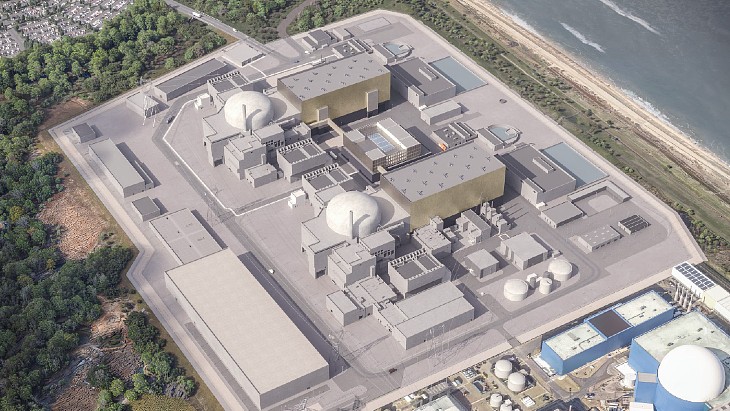
The plan is for the estimated GBP38 billion Sizewell C plant to feature two EPR reactors producing 3.2 GW of electricity, enough to power the equivalent of around six million homes for at least 60 years. It would be a similar design to the two-unit plant being built at Hinkley Point C, with the aim of building it more quickly and at lower cost as a result of the experience gained from what is the first new nuclear construction project in the UK for about three decades. Sizewell C's baseline construction cost is 22% lower than the lowest current estimate for Hinkley Point C. A final investment decision for the Sizewell C project was taken in July last year. Construction of the plant is expected to be completed by 2039.
Sizewell C has used the Regulated Asset Base (RAB) funding model, which will see consumers contributing towards the cost of new nuclear power plants during the construction phase. Under the previous Contracts for Difference system developers finance the construction of a nuclear project and only begin receiving revenue when the power plant starts generating electricity.
France's EDF, announcing the financial closing of the project in November, said it would invest a maximum of GBP1.1 billion during the construction period and would have a stake of 12.5%, with the UK government - through the Department for Energy Security and Net Zero (DESNZ) - having 44.9%, La Caisse 20%, Centrica 15% and Amber Infrastructure 7.6%.
Consumers started to pay for Sizewell C after November 2025. DESNZ expects Sizewell C to increase electricity prices for the typical household by GBP4 in 2025-26, rising up to between GBP17 and GBP19 by the time it begins operating.
The National Audit Office has now released a report that assesses the implications of the deal for taxpayers, electricity consumers, and investors, and provides a baseline against which progress can be measured.
Once construction has been completed, DESNZ's modelling predicts that the net benefits for consumers could be up to GBP18 billion, primarily delivered through energy bill savings and reduced electricity costs compared with other ways of reaching net-zero. "As a large infrastructure project, DESNZ's modelling of these benefits shows they will not outweigh the costs to consumers until after 2060," the NAO said. "They are also subject to significant uncertainty, including that other forms of net-zero technology could turn out to be cheaper or better."
"Under this innovative approach, government has provided most of the finance, but DESNZ owns a minority share of the company delivering the project," the NAO said. "This intentionally limits its control over the project. DESNZ argues this is necessary to avoid the governance weaknesses that have caused issues for previous government mega projects."
The department assumes that if the project was fully under public control the construction costs would rise to the 'higher regulatory threshold' set out in the economic licence of GBP47.7 billion, and that the involvement of private investors is justified, as their expertise will reduce construction costs and speed up delivery. The financial returns to investors will cost consumers between GBP4.0 billion and GBP4.5 billion unless they also help to cut costs and decrease delivery time by a commensurate amount.
Investors are expected to receive a rate of return of up to 13% (post-tax equity internal rate of return) assuming construction costs come in at the baseline estimate, which fall to a low of 10.8% at the higher regulatory threshold. These rates assume they sell their share of the equity once Sizewell C is operation.
"It is not clear how strongly the deal incentivises investors in Sizewell C to reduce construction costs," the report says. "Investors told us they were strongly motivated to keep construction costs below the higher regulatory thresholds. Their returns also reduce by up to 1.6 percentage points for any overruns below this threshold. However, if construction costs rise to just below this amount, investors still earn returns comparable to other utilities."
The NAO notes that, although Sizewell C should cost less than Hinkley Point C to build, it is likely that consumers will pay more for energy from Sizewell C. "This is because the price of Hinkley's electricity was set before its cost overran (which has been borne by EDF), and the cost of borrowing has also increased since then," it says.
Gareth Davies, head of the NAO, said: "Sizewell C forms a significant part of the government’s plan for a secure and affordable clean energy supply. There has been a concerted attempt to learn from the problems of previous nuclear power construction projects and other large infrastructure schemes. This has resulted in a novel financing structure and DESNZ will need to monitor the risks to taxpayers and billpayers closely."
Response to the NNAO's report, Nuclear Industry Association Chief Executive Tom Greatrex, said: "The NAO is right that Sizewell C is a generational investment. It will still be producing reliable, clean electricity well into the next century. Governments have to take decisions and make serious investments in the national interest, and that is exactly what was done here.
"The idea that Britain could have waited to see whether 'something cheaper might turn up' ignores the reality of the last decade. The UK has lived through the worst energy crisis in generations and now faces renewed instability driven by volatile international gas markets and geopolitical tensions. Britain needs secure, homegrown power that is not exposed to global fossil fuel shocks."


_42437.jpg)
_76412.jpg)
_38809.jpg)