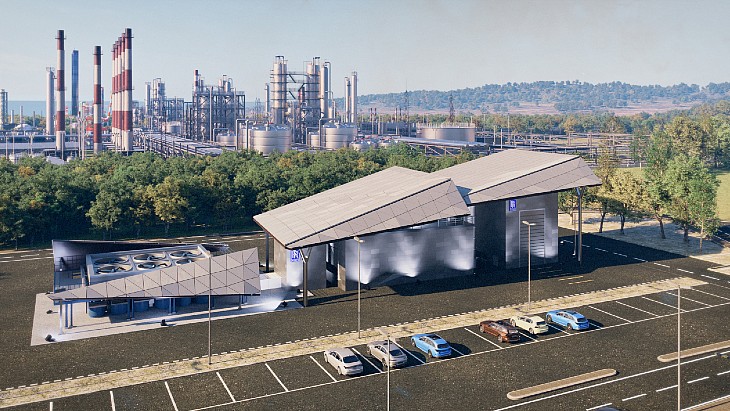
The agreements were signed during a visit to the UK by Japanese Prime Minister Sanae Takaichi. They cover what are termed High-Temperature Gas-Cooled Advanced Modular Reactor technology and expand on previous agreements between the UK's National Nuclear Laboratory (UKNNL) and Rolls-Royce, and between UKNNL and Japan's Atomic Energy Agency.
The high temperature reactors are seen as a potential way to "deliver energy resilience and enable decarbonisation across civil, defence and industrial applications" and "represent a compact and rapidly deployable nuclear energy solution for off-grid customers who require flexible heat and power that is safe, secure and reliable".
Rolls-Royce, which is part owner of Rolls-Royce SMR, whose small modular reactor has been selected for the first UK government-backed small modular reactor project in the UK, said it was "looking to broaden its nuclear portfolio and explore opportunities in the advanced modular reactor market. Differentiated in reactor technology, size and power output from the Rolls-Royce SMR, the Rolls-Royce AMR still benefits from the same innovative modular design and build certainty".
Rolls-Royce says its advanced modular reactor (AMR) "is a compact nuclear power solution designed to meet increasing demand for clean, scalable and reliable power across civil, defence and industrial sectors … perfectly placed to offer the benefits of a nuclear power solution to the sub-50 MWe scale markets".
The company says its reactor would have "a power output of up to 25 MWe/ 75 MWth per unit and can be combined in multi-unit micro-grids to meet higher power site demands".
Masanori Koguchi, Japan Atomic Energy Agency President, said of the agreements: "I hope that through our expertise in High Temperature Gas Reactor technologies, this collaboration will lead to their early deployment, a significant step towards net-zero."
Chris Cholerton, Group President, Rolls-Royce, said: "Strengthening existing relationships between our nations and combining our broad nuclear capability, will enable us to jointly address technical challenges and accelerate the development of advanced modular reactors and their advanced coated particle fuel, to deliver industrial growth, skilled jobs and energy security for our nations."
Julianne Antrobus, CEO of the UK’s National Nuclear Laboratory, said: "Advanced nuclear technologies have the potential to deliver clean, safe and reliable energy, stimulating economic growth while supporting the decarbonisation of industries that millions of people work in. The UK government’s Advanced Nuclear Framework exists to give industry a clear route to access the world-class expertise that UKNNL offers. Being contracted by Rolls-Royce to support this vital work is a strong signal that the framework is delivering and that UKNNL is playing its part in bringing the sector together."
Antrobus said it was a chance to turn "decades of research and international collaboration into real-world deployment".
The UK uses the term Advanced Modular Reactor (AMR) for the next generation of nuclear reactors. In December 2021 the government announced that the technology focus for the programme would be High Temperature Gas Reactors (HTGRs).
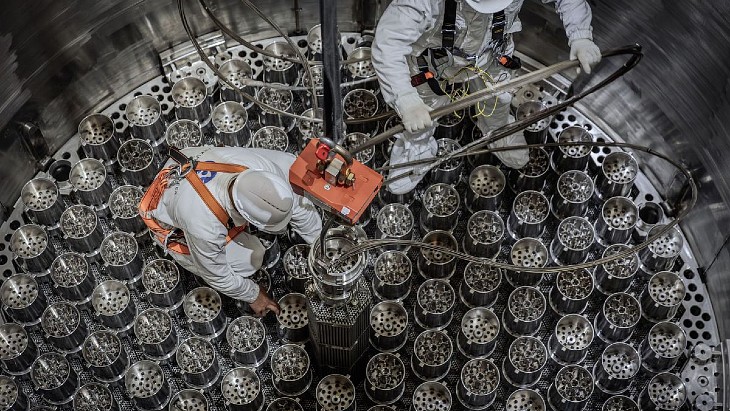
The HTGR is seen as a good fit for the UK, which founded its nuclear power sector with two generations of domestically designed gas-cooled reactors: the 26 Magnox reactors deployed in the 1960s and 1970s and the 14 Advanced Gas-cooled Reactors (AGRs) deployed in the 1970s and 1980s. The Dragon Reactor, operated from 1965 to 1975, was one of the world's first reactors to use what is now widely regarded as next-generation nuclear technology. UKNNL’s Preston laboratory has the UK’s only facility for manufacturing CPF kernels and has new coating equipment, which means it can produce coated particle fuel at scale.
Japan, through the Japan Atomic Energy Agency's High Temperature Engineering Test Reactor, has gained world-leading expertise in this field for decades.
In December 2022, the UK government announced funding of GBP60 million (USD77 million) for research into HTGRs, aimed at helping to get a demonstration project up and running by the end of the decade.
In September 2023, UKNNL and the Japan Atomic Energy Agency signed a memorandum of cooperation in the field of HTGRs, as well as a memorandum for collaboration on the next stage of the UK HTGR Demonstration Reactor programme. At the time it was said that JAEA was collaborating with UKNNL to demonstrate Japanese HTGR technology outside of Japan and to promote its social implementation with the aim of returning the decarbonisation technology to Japan.
UKNNL said that the three-way agreements "draw on the best of both nations' capabilities and position the UK and Japan to lead as global interest in advanced nuclear technology deployment grows".


_90728.jpg)
_56771.jpg)