SGE (formerly Synthos Green Energy) submitted the application under the UK's Advanced Nuclear Framework for reactors which could provide 4.2 GW of capacity, equivalent to 11% of current UK power demand.
SGE, which has BWRX-300 projects under way in Poland and elsewhere in Europe, said it has already invested GBP50 million (USD66 million) to get to the stage of submitting the UK project application, which included more than 1,500 pages. It has established SGE SMR UK Ltd as its UK-based project vehicle.
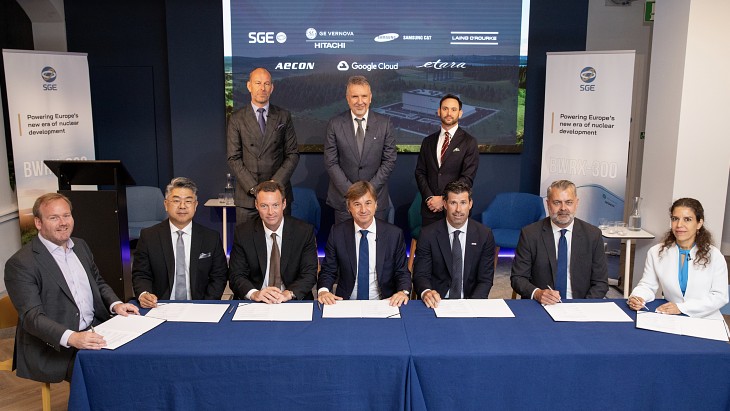
At a signing ceremony before submitting the application, SGE said that its aim was for the project to enter the UK's Advanced Nuclear Pipeline in November, with site selection and government support scheme negotiations in the first half of 2027, a final investment decision in 2030 and commercial operation of the first unit targeted for 2034.
The plan is for the initial site to host six of the 300 MW small modular reactors (SMRs), with four each at two subsequent sites. The locations of the proposed sites, and the proposed operator of the units, are said to be going to be released "in the near future", pending final negotiations.
Michał Sołowow, founder of SGE, said: "We are focused on delivering efficient, safe, affordable, and clean nuclear energy power at fleet scale. The UK is home to one of the world's most experienced nuclear workforce and the British Government has provided a clear path to market with the Advanced Nuclear Framework. Because of this, I am confident we will set a new standard for nuclear development by combining our disruptive business model with the BWRX-300's tenth generation proven technology. We will rely strongly on the UK supply chain; it is a critical element for our project."
He stressed it was a commercial approach, saying they were not asking for money from the UK government, "we are asking for the opportunity", adding that it is "our risk, if we don’t deliver".
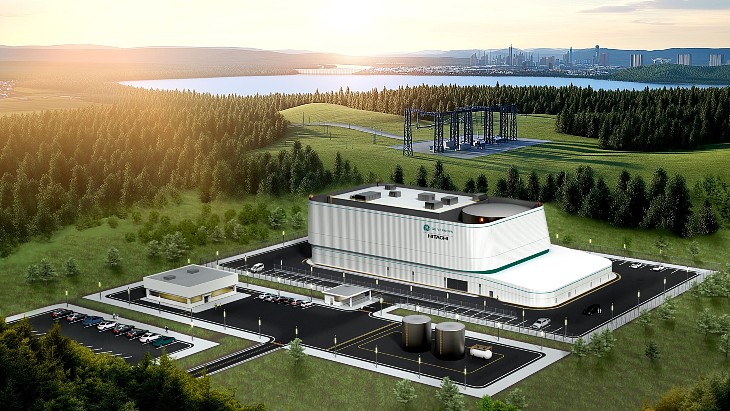
How a BWRX-300 could look (Image: GE Vernaova Hitachi)
Rafał Kasprów, CEO of SGE, said: "Standardisation, repetition, modularisation, and a fleet deployment strategy are the most effective ways to deliver new nuclear projects successfully, reducing costs, construction risk, and delivery times. We are committed to working with UK partners to provide secure, affordable, and clean electricity to millions of British households for generations to come."
Jason Cooper, CEO of GE Vernova Hitachi Nuclear Energy, said: "SGE's vision reflects the growing momentum behind new nuclear across Europe and the critical role SMRs can play in strengthening energy security while delivering reliable, lower-carbon electricity. With construction already under way at the Darlington New Nuclear Project in Ontario, Canada, the first commercial-scale SMR under construction in the Western world, the BWRX-300 offers the confidence that comes from real project execution."
John O’Connor, Group Commercial Director of Laing O’Rourke, said the company would bring nuclear experience and pioneering industrialised construction methods to the development of SMRs. Aaron Johnson, Senior Vice President, Nuclear, Aecon Group Inc, a leading partner on the Darlington BWRX-300 deployment in Canada, said "early involvement in this landmark project positions Aecon to leverage first-of-a-kind experience and tailor proven approaches for SGE in the UK and in other international markets".
Others involved in the project include Fermi Development, a UK-based developer with a decade of renewable energy development expertise, which says it has "screened more than 100 sites, with around 40 sites identified as potentially developable, enabling a fleet approach through application of a consistent model, which is central to schedule resilience, delivery and investor confidence".
Luba Kotzeva, founder and CEO of advisory and consultancy group Etara, whose team has had advisory roles on nuclear projects in 12 European countries, including the UK's Hinkley Point C, Sizewell C and Wylfa projects, said the proposed fleet-scale delivery was to capture learnings and to bring pricing down so "it is privately financeable and at affordable levels".
The project is proposing a Contract for Difference financing scheme - the type used for Hinkley Point C and preferred in European Union projects, but replaced by the regulated asset base model in the UK for the more recent Sizewell C project - which means an agreed price is set in advance for the electricity generated, with the power generator repaying the difference if the price goes above the agreed level, and the government subsidising the amount if the electricity price is below the agreed level. Under the Contracts for Difference system developers finance the construction of a nuclear project and only begin receiving revenue when the power plant starts generating electricity. Under the Regulated Asset Base funding model consumers contribute towards the cost of new nuclear power plants during the construction phase.
The project aims to learn from the experience of Contract for Difference schemes elsewhere in Europe and has proposed modifications to the Hinkley Point-style scheme to better enable private finance, with government asked to back provision of revenue support and risk sharing - including protection against future political changes of policy - "and for consumers providing a hedge for future power price shocks".
It is understood that the aim is for the level set for the Contract for Difference is to likely be in the same area as the current Hinkley Point C figure. The potential for power purchase agreements, which could also underpin financing, will also be included in the negotiations, as well as investment from the UK’s National Wealth Fund.
As to the likely cost per SMR, the project team aims that once they are in fleet mode, each SMR would cost about GBP2.2-2.5 billion (USD2.9-3.3 billion). There are plans to have some associated data centres with the SMRs, and although Google’s current role is as a technology partner SGE hopes they may become an investment partner on the data centre on the site.
Background
GE Vernova Hitachi's BWRX-300 small modular reactor is a 300 MWe water-cooled, natural circulation SMR with passive safety systems that leverages the design and licensing basis of GEH's ESBWR boiling water reactor. In December it passed Step 2 of the UK's Generic Design Assessment. The regulators said there are "no fundamental safety, security, safeguards or environmental protection shortfalls with the design that could prevent its deployment in Great Britain".
However before units could be built, the regulators would need to undertake a further period of detailed design assessment before safety-significant construction could begin and environmental permits could be issued. This assessment could be conducted on a generic basis with GE Vernova Hitachi, should the company choose to return to the GDA process to complete Step 3. Alternatively, it could be undertaken with a licensee or constructor as part of a site-specific development.
Orlen Synthos Green Energy applied to Poland's Minister of Energy last month for a Contract for Difference for the construction of a total of 14 BWRX-300 small modular reactors at three locations in Poland, the first phase of a broader OSGE programme, which ultimately includes the construction of 26 BWRX-300 units in line with the principal decisions obtained by the company from the Polish government. The aim is for the first unit to be operational in 2032.
The UK currently generates about 15% of its electricity from about 5.9 GWe of nuclear capacity. Most existing capacity is to be retired by the end of the decade, but the first of a new generation of nuclear plants is under construction at Hinkley Point C, and a final investment decision has been confirmed for a second plant at Sizewell C. Government plans call for up to 24 GWe of new nuclear capacity by 2050 to provide about 25% of electricity.
A selection contest was held for the UK government's first small modular reactor programme, which culminated last year with Rolls-Royce SMR being selected, with at least three and possibly eight of its 470 MW units set to be built at the Gwyndod site near the existing Wylfa site on Anglesey in North Wales.


_64496_89439.jpg)
_90430.jpg)
_15863_46709.jpg)
_18570_13938.jpg)