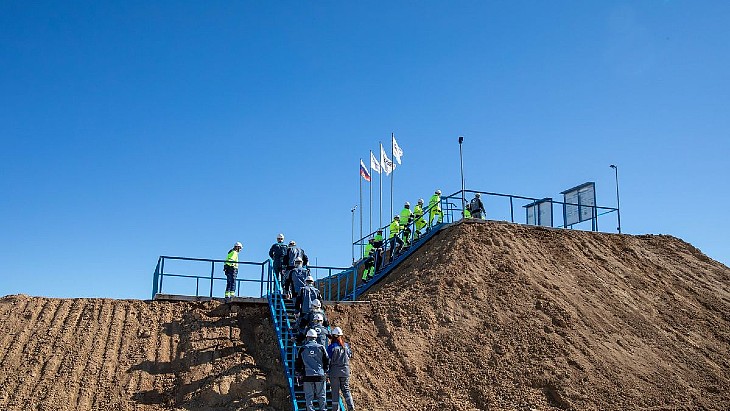
The review included the environmental impact assessement for the VVER units at Smolensk NPP-2, which the state nuclear corporation Rosatom says will form the model for future projects in the country and elsewhere.
Pre-construction infrastructure works are already taking place at the site, including the completion of a concrete mixing plant as well as roads, fencing, lighting and installing a fire-fighting water supply system. A first power line was connected to the site in August. The target is for the main construction phase to begin in March next year.
Rosatom says that the design of the plant includes "the construction of modern wastewater treatment facilities and the use of efficient gas recovery systems. A full waste management cycle is envisaged, as well as a closed-loop reactor cooling system using cooling towers, which is particularly important for preserving the ecosystem of the Desnogorsk Reservoir".
It said that experts from the Federal Service for Supervision of Natural Resources (Rosprirodnadzor) "concluded that the impact of future power units on the atmosphere, water resources, and soil will be minimal and will not exceed established standards".
Ivan Sidorov, Director of the Smolensk Nuclear Power Plant, said: "We understand our responsibility to the region's residents and future generations. The power units will meet strict environmental requirements. Nuclear power is, by definition, one of the cleanest energy sources, but public trust in it is built not on declarations, but on expert data and proven safety evidence."
The Smolensk Nuclear Power Plant, located 150 kilometres from Smolensk and 350 kilometres from Moscow, currently has three RBMK-1000 power units, which were connected to the grid, respectively, in 1982, 1985 and 1990. Each has an electrical capacity of 1,000 MW. They have each had their operating licences extended to 45 years.
Under Russia's proposed new nuclear programme, two VVER-1200 units are planned for the new phase of the Smolensk plant, to be commissioned in 2033 and 2035. They are scheduled to operate for 60 years, with potential life extensions up to 120 years.
Leonid Lebedev, Director of Design for Smolensk NPP-2 at Atomenergoproekt JSC, said: "The Smolensk NPP-2 design takes into account all the accumulated experience in the design and operation of nuclear power plants with VVER reactors … particular attention was paid to environmental impact assessment: detailed engineering surveys, public hearings, and mathematical modeling of possible impact scenarios were conducted."


_98552.jpg)
_1_12560.jpg)
_22582.jpg)


_84289_33276.jpg)