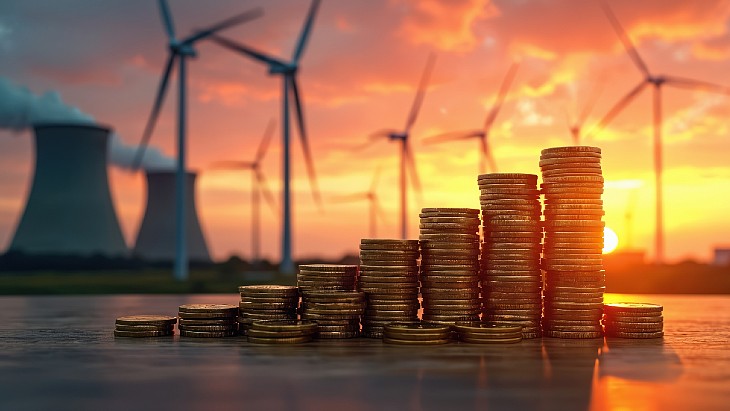
_65415.jpg)
The study investigated under which conditions the construction of new nuclear power plants may make financial sense for Switzerland's future energy system. The findings of the study are based on four different energy models. These models calculate which technologies Switzerland could use by 2050 to cover significantly higher electricity demand as cheaply as possible and in a carbon-neutral way.
Assuming that the state will continue to subsidise renewable electricity sources such as photovoltaics and wind as part of its target to expand power generation to 45 TWh and not provide any funding for the construction of new nuclear power plants, nuclear power would be too expensive under the majority of model calculations used in the study. This remains the case even with low to moderate construction costs of CHF5,000 to CHF8,000 (USD6,180 to USD9,890) per kW of installed capacity.
According to the study, however, new nuclear power plants are technologically compatible with a future energy system based primarily on solar and wind power. And in order for nuclear power to be economically competitive compared with the renewable electricity sources that are already being supported, three things are needed. Firstly, the government would have to decide to also support nuclear power as part of the 45 TWh target. Secondly, politicians would have to decide on risk reduction measures to lower the financing costs of new nuclear power plants from its estimated market rate of 8% to 5%, in line with the interest rate for other large-scale carbon-neutral plants. Thirdly, construction costs for new nuclear power plants must not be too high. With construction costs of CHF12,000 per kW, which are similar to costs recently observed in Europe and the USA, building new nuclear power plants will no longer be worth it in three of the four models – even if the government awards subsidies and bears a portion of the financial risk. But in the hypothetical scenario where construction costs of CHF5,000 per kilowatt could be achieved, it would be profitable to build between 2.6 and 4.9 GWe of new nuclear power plants. Even with moderate construction costs of CHF8,000 per kW, two out of four models still predict an installed power plant capacity of 2 GWe.
The study says Switzerland can achieve its net-zero target using existing and planned technologies without the need for new nuclear power plants with efficient electricity trading with foreign countries among the essential factors for the stability of a system that does not include nuclear. The models show that new nuclear power plants would reduce net electricity imports in winter overall, but not eliminate them entirely. Depending on the model, net electricity imports in winter could be reduced by 1 to 6 TWh - 3 to 20% of the electricity currently generated between October and March.
"Each of these models is based on a range of assumptions that are associated with uncertainties and simplify the complexity of the energy system," said André Bardow, Professor at ETH. "In cases where these models point in the same direction, there are robust findings that could form the basis for discussion by society and in the sphere of politics. As for whether to decide for or against nuclear power, this is ultimately a question for society."
Andreas Pautz, Head of the PSI Centre for Nuclear Engineering and Sciences, Professor of Reactor Physics and Systems Behaviour at EPFL and one of the study's authors said: "This goes to show how crucial construction costs are for nuclear power plants to be competitive. Prices for new nuclear power plants recently seen in the US and Europe can also be attributed to the fact that they are the first projects of their kind. At best, nuclear energy will only be competitive in Switzerland if manufacturers successfully learn the lessons of these cost overruns and limit the costs of future plants to around CHF8,000 per kW."
The Swiss Nuclear Forum welcomed the study, saying it shows "that new nuclear power plants can be part of a cost-optimised, climate-neutral Swiss energy system under certain economic and regulatory conditions".
Hans-Ulrich Bigler, President of the Swiss Nuclear Forum, said: "The study is not a rejection of new nuclear power plants. Instead, it shows under what conditions nuclear energy can be economically integrated into the future Swiss energy system. Ultimately, the framework conditions that will apply in the future are a political decision ... Lifting the legal ban on new construction is the right way forward. Those who want to make technology-neutral decisions shouldn't exclude one option by law today. Whether and when new nuclear power plants are actually built will be determined later by economic viability, willingness to invest, and future electricity demand."
Background
Switzerland currently has four nuclear power reactors - two at the Beznau plant and one each at the Gösgen and Leibstadt plants - generating about one-third of its electricity. They all have an unlimited operating licence and can be operated as long as they are safe.
A new Swiss energy policy was sought in response to the March 2011 accident at the Fukushima Daiichi plant in Japan. Two months later, both the Swiss parliament and government decided to exit nuclear power production. The Energy Strategy 2050 initiative drawn up by the Federal Council came into force on 1 January 2018 and calls for a gradual withdrawal from nuclear energy. It also foresees expanded use of renewables and hydro power but anticipates increased reliance on fossil fuels and electricity imports as an interim measure.
In August last year, Switzerland's Federal Council presented draft legislation that would remove the country's ban on the construction of new nuclear power.
The publication of the study by ETH Zurich and the Paul Scherrer Institute comes as the 'No to New Nuclear Power Stations' coalition - comprising the Greens, the Socialist Democrats, the Green Liberal Party and various other organisations - launched a popular initiative to block the construction of new nuclear power plants in Switzerland. Building new nuclear plants would make the country dependent on foreign energy, cost billions and hinder the development of renewable energy, according to the initiative committee. The committee has until 8 October to collect 50,000 signatures for the referendum to go ahead.
An online poll conducted in September 2024 found that 53% of the Swiss population supports the government's plan to remove the country's ban on the construction of new nuclear power plants.


_33474.jpg)
_37830.jpg)
_85344.jpg)