_80776.jpg)
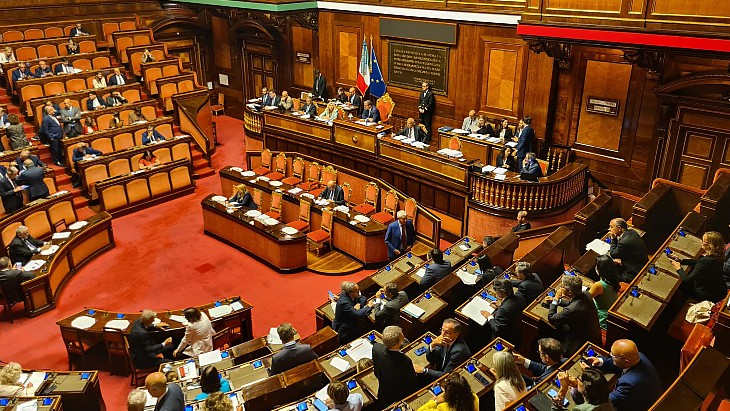
In May last year, Sweden's parliament - the Riksdag - approved the government's proposals for providing state aid to companies that want to invest in new nuclear reactors in the country. The loans - aimed at lowering the cost of financing new nuclear - will be limited to the equivalent of four large-scale reactors (about 5000 MWe of capacity). The government noted that support may only be granted if the new reactors are sited at the same location and have a total installed output of at least 300 MWe. Two-way Contracts for Difference may be entered into once a new reactor has become operational and has been licensed to produce electricity at full capacity. The new act on state aid entered into force on 1 August, since when interested companies have been able to apply for the aid.
The Swedish government received an application for state aid in December to support proposals for either five GE Vernova Hitachi BWRX-300 reactors or three Rolls-Royce SMRs to provide about 1,500 MW capacity at the Ringhals site on the Värö Peninsula. The application came from Videberg Kraft AB, a project company owned by Vattenfall AB (80%) and backed by a series of industrial firms via the Industrikraft i Sverige AB consortium (20%).
The government has now said it is seeking authorisation from the Riksdag to acquire shares in Videberg Kraft in 2026 and 2027, giving the state a voting and ownership share of 60%, and to decide on an initial capital injection to the company of a total of no more than SEK1.8 billion (USD190 million). The government intends to enter into an agreement to acquire shares in Videberg Kraft in 2026. The formal transfer of the shares is expected to take place in the second half of 2027.
The government said it believes that there should be the possibility of increasing or decreasing the state's voting and ownership share in the company, and is therefore requesting authorisation to adjust the ownership in the range of 51–65% until the reactors are completed and put into operation. Authorisation is also requested to be able to contribute capital to the company of a maximum of SEK34.3 billion during the construction period, provided that other owners also contribute their share of the capital. Funds for future capital contributions are estimated from 2030 onwards Both of these authorisations shall be valid until the reactors are put into routine operation, but not until 2045 at the latest.
The government also said that clarity was also needed regarding financing the disposal of used nuclear fuel and radioactive waste from new nuclear power reactors in a new nuclear waste programme for actors who want to build new reactors. It is seeking authorisation to enter into agreements with Videberg Kraft in 2026 and 2027 regarding the proportion of fixed costs and increases in fixed costs in a new nuclear waste programme that the company and the state will be responsible for. The expected fixed costs for a new nuclear waste programme are estimated to total about SEK122 billion at 2026 prices. In order for Videberg Kraft, as the first actor to enter a new nuclear waste programme, not to have to risk bearing the entire fixed cost and being solely responsible for the new programme, the government believes that a state commitment is justified.
"The proposal means that the state should be able to negotiate to assume financial responsibility for a share of fixed costs with the first actor while waiting for new actors to enter a new nuclear waste programme based on established technology," the government said. "The authorisation is proposed to amount to SEK122 billion and SEK61 billion for possible increases in the 2026 price level between the years 2035–2159, which is only the framework for what the state can negotiate and agree on. A prerequisite for being able to enter into the agreement is that the support is compatible with the EU's state aid rules."
For each new actor that invests in new nuclear power and that joins a new nuclear waste programme, the state's commitment will decrease. In the case of investments in new nuclear power that relate to a total electrical output of approximately 5,000 MW, the state's commitment for the nuclear waste programme's expected fixed costs ceases, as it is then borne by the actors.
"The authorisation for fixed costs for a new nuclear waste programme can be expected to involve expenditure for the state only from 2035 onwards through 2159," it said.
Minister of Energy and Enterprise Ebba Busch said: "Sweden is a nuclear power nation, and is now becoming even stronger. As industry is electrified and the need for electricity grows, long-term solutions are required. The government is now taking the next step to clarify the state's role and responsibility in the further expansion of nuclear power."
In February, the government announced several proposed measures to make it easier to establish new nuclear power in Sweden. These include a new approval law, more possible locations for nuclear power on the coast, and increased government support for municipalities' feasibility studies.


_76412.jpg)
_38809.jpg)
_15774.jpg)