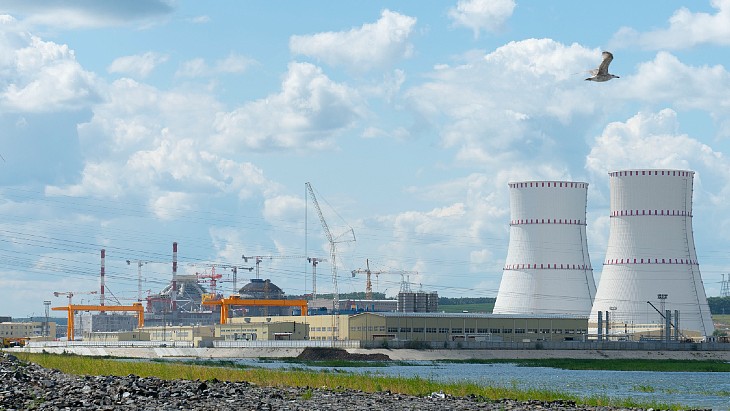
The VVER-TOI is Russia's most powerful nuclear power unit. It was commissioned and officially transferred to operational status and entered the energy and capacity market and began supplying Russia's Unified Energy System at the start of the month.
Kursk Nuclear Power Plant Director Alexander Uvakin said: "Thanks to the VVER-TOI, the Kursk NPP has joined the ranks of Russia's largest nuclear power plants, operating at over 3,000 MW. Every billion kWh contributes to energy independence, industrial development, and the comfort of tens of thousands of families."
Construction is under way on units 2 and 3, which will also be VVER-TOI reactors. The plan is for there to be four units at the plant, providing a total capacity of 5,000 MW.
Rosatom says that more than 90,000 people and about 250 contractors and subcontractors took part in the project for the first new unit.
The start of commercial operation followed a period of pilot industrial operation - and the conducting of more than 1,500 tests of the power unit's systems and equipment - before the go-ahead from regulator Rostekhnadzor was issued 27 April.
Background
Kursk II is being built near the existing Kursk nuclear power plant in western Russia, about 60 kilometres (37.5 miles) from the Ukraine border. It will feature four of the new VVER-TOI reactors, the latest version of Russia's large light-water designs. They have upgraded pressure vessels and a power rating of 1,250 MW.
Construction of the first unit began in 2018, its polar crane was installed in October 2021 and the reactor vessel was put in place in June 2022. Concreting of the outer dome of the first unit was completed in August 2023. With the second and third units also under construction, the target is for all four units to be in operation by 2034.
Rosatom says the service life of the main equipment has doubled, and that the VVER-TOI units feature a mix of passive and active safety systems and include a core meltdown localiser. It can also operate with 100% mixed oxide fuel containing uranium and plutonium (MOX fuel).
The new units at Kursk II will replace the four units at the existing, nearby nuclear power plant, which are scheduled to all have shut by 2031.
The first unit was shut down after 45 years of operation in December 2021 and the second unit followed in January 2024. The original design life for the four RBMK-1000 reactors at the plant was for 30 years but had been extended by 15 years following life extension programmes.


_83018_1b29bf06_32867.jpg)
_22748.jpg)
_85344.jpg)