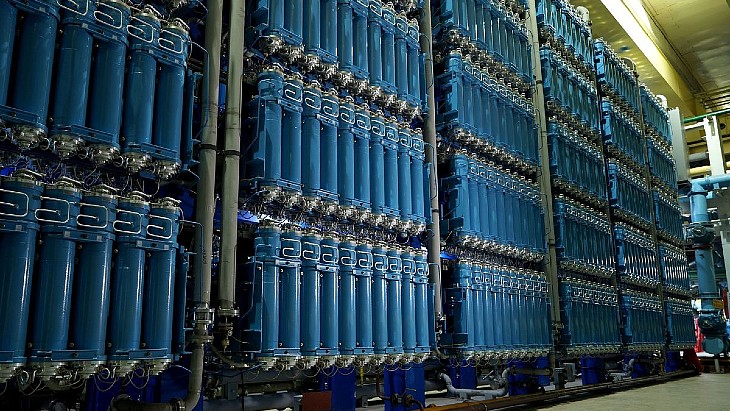
It becomes the third of Rosatom’s four uranium enrichment sites to introduce the newest generation of centrifuges, following upgrade projects launched in 2018 at the Urals Electrochemical Combine and the Electrochemical Plant in Siberia.
Commissioning of the new centrifuges at the Isotope Separation Plant is scheduled to be completed in 2027. The fourth facility to be upgraded will be the Angrask electrolysis Chemical Plant in the Irkutsk region, Rosatom said.
Natalia Nikipelova, President of TVEL, said they had been "fulfilling a record-high production programme for several years in a row, but at the same time we are steadily implementing large-scale modernisation projects at all stages of the nuclear fuel cycle that our enterprises are involved in. Rosatom has already invested heavily in modernising nuclear fuel fabrication, uranium enrichment and conversion facilities, as well as manufacturing of gas centrifuges for isotope separation. This work will become the foundation for fulfilling the ambitious goals for the production of enriched uranium and nuclear fuel for operating nuclear power plants and the ones under construction in Russia and abroad".
In July TVEL said work was already progressing on a 10th-generation gas centrifuge. It said it was preparing for pilot industrial operation at one of its sites as part of the development work.
It stressed that the 9+ generation gas centrifuges would operate for decades. The differences between the various generations was not specified beyond "the growth of their efficiency and productivity".
Background
Unenriched, or natural, uranium contains about 0.7% of the fissile uranium-235 (U-235) isotope. ("Fissile" means it's capable of undergoing the fission process by which energy is produced in a nuclear reactor). The rest is the non-fissile uranium-238 isotope. Most nuclear reactors need fuel containing between 3.5% and 5% U-235. This is also known as low-enriched uranium, or LEU. Advanced reactor designs that are now being developed - and many small modular reactors - will require higher enrichments still.
Enrichment increases the concentration of the fissile isotope by passing the gaseous uranium hexafluoride through gas centrifuges, in which a fast spinning rotor (a thousand revolutions per second) inside a vacuum casing makes use of the very slight difference in mass between the fissile and non-fissile isotopes to separate them. As the rotor spins, the concentration of molecules containing heavier, non-fissile, isotopes near the outer wall of the cylinder increases, with a corresponding increase in the concentration of molecules containing the lighter U-235 isotope towards the centre. World Nuclear Association’s information paper on uranium enrichment contains more details about the enrichment process and technology.


_33441.jpg)
_17445.jpg)
_18654.jpg)