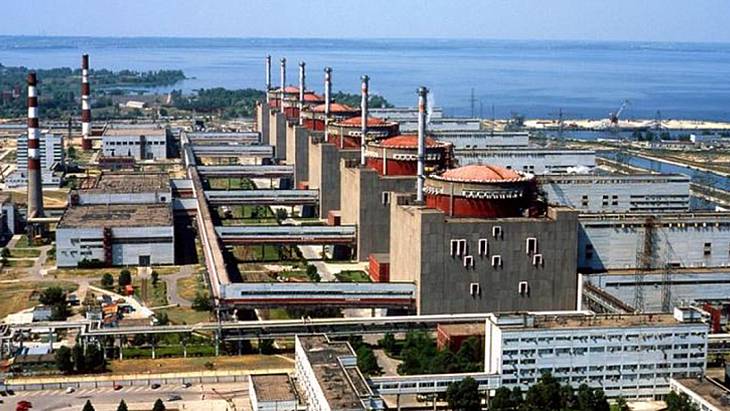
The agency (IAEA) said its experts at the site had been informed by the operators of the plant - which has been under Russian military control since March 2022 - that "the measure is intended to increase the time available before water could begin to boil off in the event of a prolonged loss of off-site power during which the site exhausted its diesel fuel supplies and could no longer continue cooling the pools".
The IAEA added: "The decision was taken in light of the prolonged unavailability of the 750 kV Dniprovska line and current challenges in resupplying the site’s diesel fuel stores because of military activity in the area. The work began this week, with the IAEA team present to observe."
Cooling pools are used for storing used nuclear fuel underwater. This is normally for at least five years to allow decay of radioactivity and heat.
The Zaporizhzhia plant's six units have all been shut down since the start of the war in 2022, with the last unit transferring to a cold shutdown in April 2024.
The plant is close to the front line of Russian and Ukrainian forces and the plant has suffered a number of incidences where it has lost all external power, and had to rely on its fleet of emergency diesel generators for the power needed for essential safety functions. Nuclear power plants generally have enough diesel stored on site to operate emergency generators for an initial seven days if necessary. This ensures there is time to fix external power issues, or allow time for new supplies of diesel to be brought in if the generators are to be in use for a longer period.
According to the IAEA there have now been 24 times that the plant has lost external power, with half of those occurring in the past four months, including twice in the past week.
Director General Rafael Mariano Grossi said: "This trend, with the rising number of off-site power cuts at the Zaporizhzhia Nuclear Power Plant, is deeply concerning and clearly not sustainable. The agency will continue its work to help improve the situation and support nuclear safety and security at the site."
At the moment the plant is relying on a single 330 kV backup power line, with its main 750 kV power line unavailable since March. Repairs were carried out, under an IAEA-arranged localised ceasefire, but it remains unavailable because of damage to a substation which provides power to the line.
Grossi said: "These substation missions have a clear nuclear safety and security purpose. As set out in the seven indispensable pillars, nuclear power plants require reliable off-site power, and substations are a crucial part of that process."
The IAEA said that its teams at Zaporizhzhia and at the South Ukraine Nuclear Power Plant and the Chernobyl site all continue to report hearing military activity and/or air raid alarms.
Grossi said: "With each new day of the conflict, the risks to nuclear safety and security are not decreasing, on the contrary. I renew my call for maximum military restraint around all of Ukraine’s nuclear power plants and their associated electrical infrastructure."


_29250_15814.jpg)
_29695_19459.jpg)
_98552.jpg)
_1_12560.jpg)