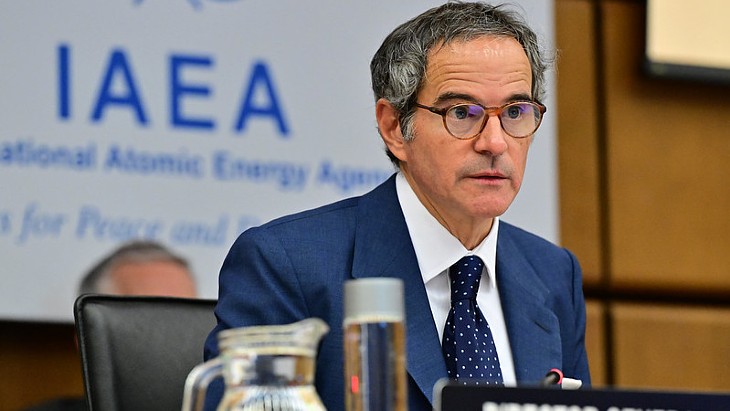
Grossi, responding to a media question about whether nuclear power plant design safety standards needed to be reviewed as a result of military action near them, said safety standards were kept under constant review, although he did not feel there was a need for a big overhaul.
However there was an increased emphasis on emergency preparedness and response, he said, praising the reaction of the operators of the Barakah Nuclear Power Plant in the UAE after an electrical generator located outside the inner site perimeter of the NPP was damaged by a drone on 17 May - "they demonstrated the professionalism, skills and preparedness that nuclear safety demands every day", he said.
"The UAE never imagined in their wildest dreams that one day Barakah would be attacked," he added at the media briefing after his opening address to the IAEA Board of Governors' meeting.
"I am sure that there will be analysis and evaluation - there is going to be, for example, a further look into the layout of external power supply lines ... sometimes the connections and inter-connections are not designed for situations where loss of outside power could happen more frequently."
He was speaking on the same day that a localised ceasefire was agreed in an area near the Zaporizhzhia Nuclear Power Plant to allow repairs to be carried out to the external Dniprovska 750 kV power line, which has been disconnected for more than two months. In the past few days the plant, which has been under Russian military control since March 2022 and is located close to the frontline of Russian and Ukrainian forces, has suffered its 17th loss of external power, when its sole remaining back-up 330 kV lost connection. During its loss of external power, it has had to rely on emergency back-up diesel generators to provide the power required for essential safety and cooling functions.
The ceasefire, the sixth temporary ceasefire that the IAEA has negotiated with Russia and Ukraine to secure off-site power and ensure nuclear safety, was "complicated by the location of the power line damage: on top of high pylons across the line of control in the Dnipro River". Precise timing and coordinates were agreed by both sides "for the sake of nuclear safety".
In his remarks to the IAEA Board of Governors he referenced drones causing damage in the area of Zaporizhzhia Nuclear Power Plant and Bushehr Nuclear Power Plant in Iran, as well as at Barakah, and urged restraint, warning of the risks if a nuclear accident was caused. In all the cases referred to, there has been no release of radiation as a result of the incidents.


_55605.jpg)


_18654.jpg)