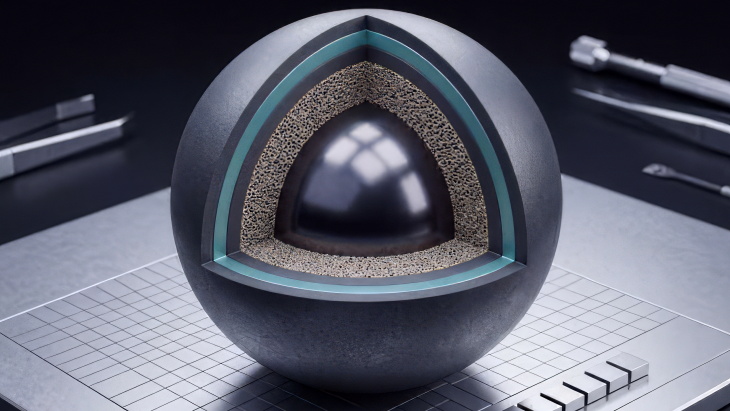
The collaboration will evaluate and optimise liquid-metal-jetting technology to produce highly uniform, spherical thorium-232 kernels for tri-structural isotropic (TRISO) fuel. The Thorium Unimodal Droplet Ejection for Reactors (Thunder) project builds on previous research (PowderJet) led by Lawrence Livermore National Laboratory (LLNL) Research Engineer and Principal Investigator Viktor Sukhotskiy and his team where a new particle production prototype was built using droplet-based liquid-metal-jetting technology.
The work includes computational modelling, materials and nozzle compatibility testing, high-temperature process development, particle characterisation, safe radiological handling, and transfer of scalable process and design rules to support future commercialisation.
The goal is to enable resilient, cost-effective and sustainable manufacturing of advanced TRISO fuel, accelerating Ampera's strategy to establish a scalable and secure domestic advanced nuclear fuel supply chain.
"Lawrence Livermore National Laboratory has a long and distinguished record of translating advanced science into technologies of national importance," said Ampera founder and CEO Brian Matthews. "Developing a scalable domestic capability to manufacture advanced nuclear fuel is fundamental to Ampera's strategy. We believe this collaboration can accelerate the technical foundation required to vertically integrate our fuel supply, reduce cost and supply-chain risk, and support the deployment of our compact subcritical nuclear energy systems."
"Public-private projects like this show the value of connecting LLNL's world-class research capabilities with industry partners who have a clear technology need and sharp commercial focus," said Sukhotskiy. "Working with Ampera gives us the opportunity to apply joint expertise to a challenging nuclear fuel problem, while also continuing to mature liquid metal jetting as an advanced manufacturing technology. That combination, balanced with scientific progress, technology transition and national security relevance, is what makes the collaboration so exciting."
He added: "Project Thunder shows how early LLNL investment in manufacturing and materials science can lead directly to external partnerships in strategically important technology areas. PowderJet grew out of foundational work in liquid metal jetting, and we are now applying it to a challenging nuclear fuel problem with real commercial relevance."
Ampera is developing subcritical thorium-based microreactor systems that are energy dense and can operate for up to 30 years without refuelling. Through its proprietary TRISO fuel platform, neutron-source technology and advanced additive manufacturing, it aims to deliver scalable, factory-built, rapidly deployable, emission-free power for data centres, defence, industrial and maritime applications. Unlike conventional reactors, subcritical systems rely on an external neutron source to initiate and sustain operation, creating an additional layer of operational control while enabling innovative fuel-cycle approaches.
In June, Ampera announced that its energy system will be fuelled by thorium procured from Australia and produced in-house by the company, as it aims to vertically integrate the entire fuel value chain. In February, Ampera formed Ampera Australia Pty Ltd to expedite the procurement and import of thorium to the USA. This followed the October 2025 announcement by the governments of the USA and Australia of a framework for securing supply in the mining and processing of critical minerals and rare earths.
In February, Ampera submitted a formal letter to the US Nuclear Regulatory Commission indicating its desire to begin the pre-application process for its factory-fabricated, containerised microreactor, and in April, it entered into a strategic collaboration with Monaco-based shipping company Scorpio Tankers Inc to jointly develop and commercialise advanced microreactors for marine, shipping and related maritime applications. The same month, Ampera opened its global headquarters in Florida. It has said it plans to produce TRISO thorium kernels at another location in the state.


_33441.jpg)
_17445.jpg)