The two countries have had agreements on cooperation in the area of peaceful uses of nuclear technology dating back to 1976.
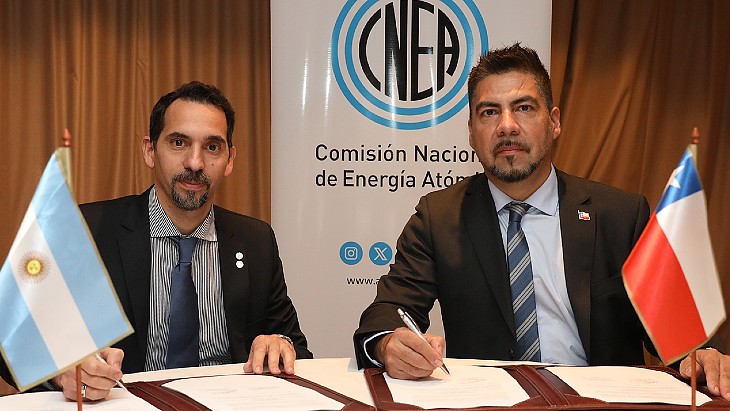
This latest agreement was signed by representatives of Argentina's National Atomic Energy Commission (CNEA) and the Chilean Nuclear Energy Commission (CCHEN).
It was signed for the Argentine side by CNEA President Martin Porro, who called it "an important milestone in the field of bilateral and regional cooperation, given that the Chilean Nuclear Energy Commission is an institution with which we have been working closely for years on a wide variety of issues, including within the framework of International Atomic Energy Agency initiatives such as the Latin American Research Reactor Network".
Richard Gonzalez, acting executive director of Chile's CCHEN, said: "We are very pleased to have consolidated and finalised this cooperation and mutual collaboration agreement. This will boost science and technology in our country … working in collaboration with the CNEA allows us to enhance our technological development in Chile."
The form of cooperation set out in the agreement includes information exchange technical visits and joint research and technological development projects and programmes.
The two organisations said the areas covered are: research reactors and their applications; radiopharmaceuticals; applications of nuclear technology in health, agriculture, industry and mining; nuclear and radiological safety; human resource training; used fuel management; modernisation and management of technological aging, especially of nuclear reactors; and scientific and technical assistance in nuclear power.
Argentina has three nuclear reactors generating about 7% of its electricity. Its first commercial nuclear power reactor began operating in 1974. It had been developing the CAREM25 small modular reactor, but work on that has been halted under the current government. Uranium exploration and some mining was carried out from the mid-1950s, but the last mine closed in 1997 for economic reasons. It also has a long history with research reactors, including the RA-10 research reactor which is currently under construction.
The Chilean Nuclear Energy Commission has operated the RECH-1 research reactor since 1974. This reactor is located at La Reina Nuclear Centre in Santiago. It is a 5 MW pool-type reactor using low-enriched uranium fuel assemblies, light water as moderator and coolant, and beryllium as reflector. The main use of the RECH-1 reactor is the production of radioisotopes, mainly for medicine. In addition, irradiation of samples is carried out for chemical analysis and geological material, for purposes of determining age and preparing radioactive tracers. Chile does not have any nuclear energy plants, but there have been various proposals to develop some in the past.


_56771.jpg)
_21742.jpg)
_77890.jpg)