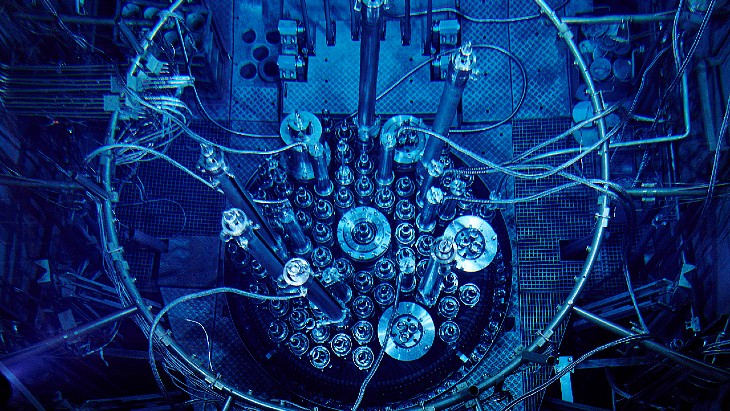
The French-based fuel specialist will supply high-density silicide low-enriched uranium (HD LEU) fuel elements for the 100 MWt reactor, which is a key global producer of medical radioisotopes.
Framatome delivered three Lead Test Assemblies (LTAs) in April 2025 of HD LEU to qualify as an approved supplier for the BR2 reactor. The LTAs have been "successfully irradiated in the BR2 reactor, going through a representative series of operating cycles for standard driver fuel elements, without any reported defect or irregularity", Framatome said.
Ralf Gathmann, Vice President of CERCA at Framatome, said: "This contract represents an important step in demonstrating Europe's capabilities in the nuclear field and in strengthening European supply‑chain expertise for the production of medical radioisotopes."
Steven Van Dyck, BR2 Director at SCK-CEN, said: "This step reinforces our roadmap towards BR2's future conversion to low-enriched uranium. With the successful irradiation of these LTAs, we can consider Framatome as a qualified supplier of LEU fuel for BR2 and, combined with this new fuel supply contract, we can count on them as a trusted partner for future fuel deliveries. We are ready to start using this fuel as soon as we receive official approval from the Belgian nuclear authority."
Framatome said it was now focused on full industrial-scale production of HD LEU fuel elements.
Background
The BR2 is one of three operating research reactors at SCK-CEN in Mol, northeast Belgium. In operation since 1963, the BR2 is one of the oldest research reactors in Western Europe. The reactor is due to have its next periodic safety review later this year, when a decision will be taken on operation for a subsequent 10 years.
The BR2 accounts for about a quarter of the global production of radioisotopes for medical and industrial purposes, including for cancer therapy and medical imaging. It also produces doped silicon, which forms a semiconductor material that provides the basic substance for electronic components.
Most of the world's research reactors were built in the 1960s and 1970s using technology that required high-enriched uranium (HEU) - with enrichment levels as high as 98% - to perform experiments. HEU targets have also been used in the production of medical radioisotopes. However, such HEU could potentially be used to make a nuclear weapon and is therefore seen as a proliferation risk. Much of this research can now be carried out using LEU, of which uranium-235 accounts for less than 20%.
CERCA is Framatome's subsidiary for the fabrication of fuel elements for research reactors and supplies almost all European research reactors and a significant share of research reactors across the globe. More than 20,000 fuel elements have been manufactured by CERCA for research reactors around the world. 75% of the world's technetium-99m scans are performed using medical targets produced by CERCA.


_76412.jpg)
_38809.jpg)
_15774.jpg)
_29250_15814.jpg)