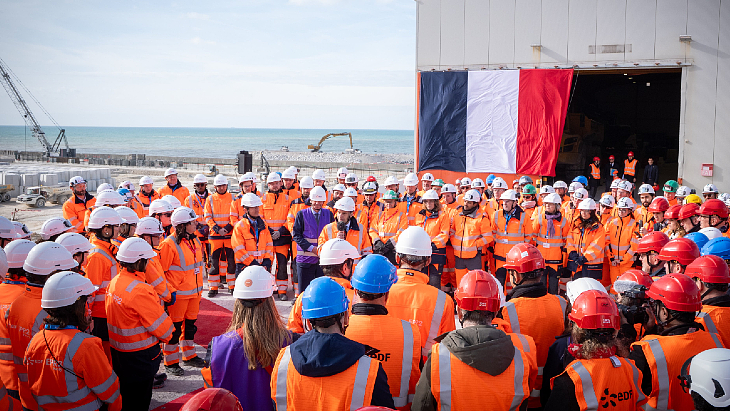
At a 12 March meeting of the Nuclear Policy Council (CPN) at the Penly nuclear power plant site in northern France, the council took note of the progress made in implementing the EPR2 programme, which aims to build six new high-power reactors at the existing Penly, Gravelines, and Bugey sites. The council also acknowledged the conclusions of the audit of the EPR2 reactor construction programme, conducted in early 2026 by the Interministerial Delegation for New Nuclear Energy (DINN). EDF committed to meeting the construction cost target of EUR72.8 billion (USD83.7 billion) and the programme schedule. The council asked EDF to implement the identified recommendations by the end of 2026 and to report on them as part of the monitoring carried out by the Interministerial Delegation for New Nuclear Energy.
The Nuclear Policy Council also confirmed the main principles and parameters of the financing and regulatory framework for the EPR2 programme. The subsidised loan from the State granted to the EPR2 programme for 60% of the total amount of the programme will be financed by the savings fund of the Caisse des Dépôts.
The council confirmed the objective of ensuring the final investment decision of EDF's Board of Directors before the end of 2026, for initial commissioning by 2038. It therefore asked all State services and EDF to take all necessary measures to finalise the ongoing discussions with the European Commission on a timetable consistent with this objective.
They also noted progress made on the Aval du Futur (Downstream of the Future) programme led by Orano, which aims to modernise the facilities at the La Hague nuclear fuel cycle plant to meet the needs of the existing nuclear fleet and later the EPR2 reactors. The first phase involves the construction, by 2040, of two used fuel storage pools, a new storage facility for plutonium-bearing materials, and a new reprocessing plant called Melox 2. The second phase focuses on the construction of a new used-fuel reprocessing plant called La Hague 2 and a third used-fuel storage pool. The Nuclear Policy Council also welcomed the agreement in principle reached between Orano and EDF, which will ensure the programme's progress up to the final investment decisions. It asked them to finalise, in conjunction with the government and by the end of 2026, the terms of the programme's financing agreement to guarantee the commissioning of the first phase of the project by 2040. It confirmed the programme's 'Major Project' designation and asked government departments to implement the necessary measures to expedite procedures and simplify the programme's requirements.
The Nuclear Policy Council also confirmed the launch of a new programme to close the nuclear fuel cycle. This programme aims to mobilise all stakeholders (contractors, researchers, and emerging players) and eliminate the need for natural uranium imports by 2100. The council said it has decided to launch a four-year study phase to design these facilities and then to consider, by 2030, the start of construction on the first fast-neutron reactor. The council requested that the financing plan incorporate European and international partnerships, as well as contributions from industry. It said engaging all stakeholders, particularly emerging players, in this strategy will be a key challenge.
Finally, the Nuclear Policy Council welcomed the announcement of additional funding for two small modular reactors - Calogena and Jimmy - within the framework of the France 2030 programme. The council also noted the continued review of other applications, which will allow for the allocation of additional funding to other projects in the coming months.
In a joint statement, EDF, Framatome (an EDF subsidiary), Orano and the Alternative Energies & Atomic Energy Commission (CEA) welcomed the outcomes of the CPN meeting. "These outcomes confirm the French State's commitment to ensuring the long-term continuity and development of the nuclear sector, with the objective of guaranteeing competitive, sovereign and low carbon electricity ... the French nuclear sector stakeholders, represented by EDF, Framatome, the CEA and Orano, share the conviction, reaffirmed by the CPN (Nuclear Policy Council), that nuclear electricity generation is essential to France's energy and industrial sovereignty, and ensures a long-term supply of competitive, low‑carbon electricity."
Set up by former President Nicolas Sarkozy in 2008, the CPN is a top-level ministerial council on nuclear energy policy. The council sets main policy features as well as their implementation in terms of export, international cooperation, industrial policy, energy policy, research, safety, security and environmental protection.
In February 2022, Macron announced that the time was right for a nuclear renaissance in France, saying the operation of all existing reactors should be extended without compromising safety and unveiling a proposed programme for six new EPR2 reactors, with an option for a further eight EPR2 reactors to follow. The first three pairs of EPR2 reactors are proposed to be built, in order, at the Penly, Gravelines and Bugey sites. Construction is expected to start in 2027. The cost was originally estimated at EUR51.7 billion (USD56.4 billion), but this was revised to EUR67.4 billion in 2023.
The EPR2 reactor is a pressurised water reactor project developed by EDF and Framatome. It meets the general safety objectives of the third generation of reactors. Its aim is to incorporate design, construction and commissioning experience feedback from the EPR reactor, as well as operating experience from the nuclear reactors currently in service.


_42437.jpg)
_76412.jpg)