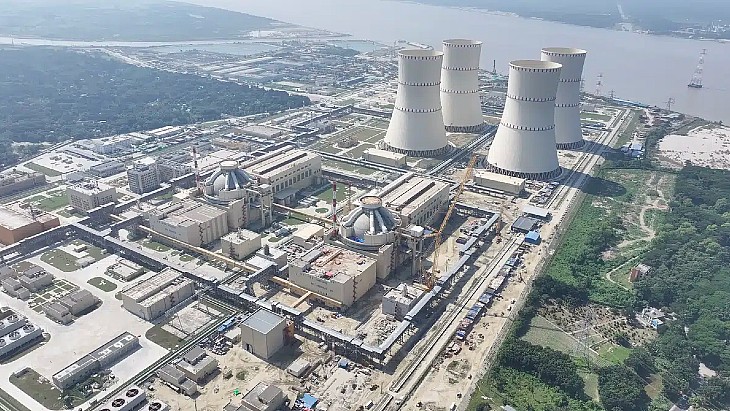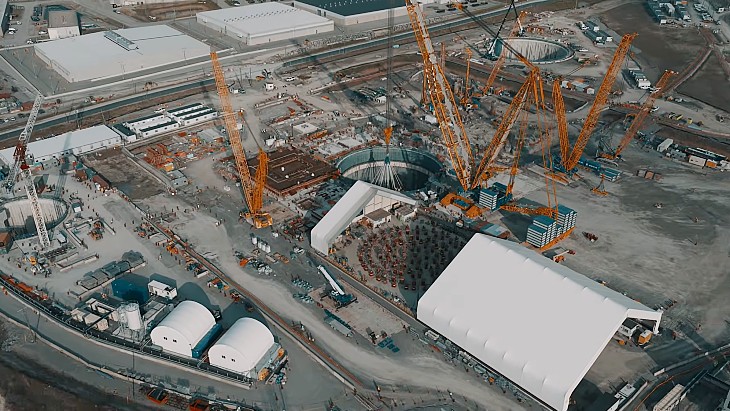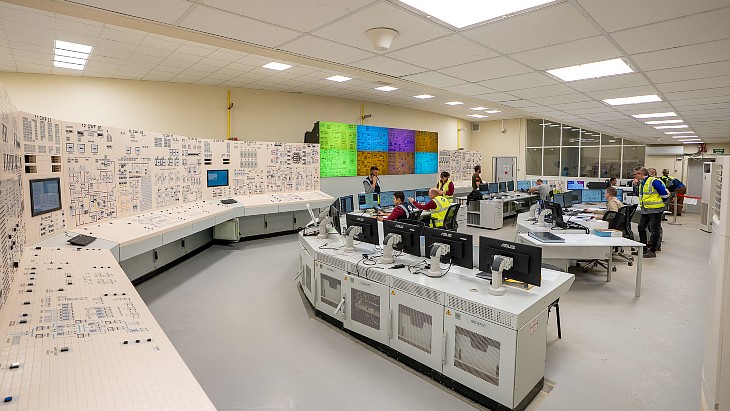
Akkuyu Nuclear Power Plant's unit 1 will have all its equipment in the primary and secondary circuits tested under operating conditions - with checks of equipment strength, piping, vibration, safety systems, reactor control and protection systems. These tests all take place with dummy fuel assemblies loaded, instead of real nuclear fuel.
The commissioning programme involves "gradually warming up the reactor unit and increasing the temperature and pressure of the primary coolant (desalinated water) to their rated values of 285°C and 16.5 MPa. This pressure is comparable to that experienced by objects submerged at a depth of 1,650 metres and keeps the water in a liquid state", Akkuyu Nuclear JSC explained.
Once the tests are completed, the Turkish nuclear regulator will inspect the unit to ensure it complies with design requirements before deciding on a permit to allow the loading of nuclear fuel assembles and the physical start-up of the reactor.
Sergei Butckikh, Akkuyu Nuclear CEO, said: "Nuclear safety principles require us to verify the operational readiness of every system and piece of equipment. Before loading fuel, we systematically test them under a range of operating conditions, including simulated deviations from normal operation. We must ensure that the equipment operates reliably and that the safety systems fully perform their intended functions. The power unit’s readiness for physical start-up will be confirmed based on the results of all tests scheduled for this stage of commissioning."
Earlier this week Strana Rosatom, the in-house publication of Rosatom, Russia's state nuclear corporation, reported Rosatom Director General Alexei Likhachev as saying that if the tests prove successful, he hoped to see the loading of nuclear fuel as early as December. He told the official Tass news agency "this is a kind of final check; actually it is a final inspection of all plant systems. I strongly hope that it will go without drawbacks and as we promised, we will initiate physical launch this year".
Background
Akkuyu, in the southern Mersin province, is Turkey's first nuclear power plant. Rosatom is building four VVER-1200 reactors, under a so-called BOO (build-own-operate) model. According to the terms of the 2010 Intergovernmental Agreement between the Russian Federation and the Republic of Turkey, the aim was for the commissioning of the first power unit of the nuclear power plant to take place within seven years from receipt of all permits for the construction of the unit.
The licence for the construction of the first unit was issued in 2018, with construction work beginning that year. Nuclear fuel was delivered to the site in April 2023. The aim has been for unit 1 to begin supplying Turkey's energy system by the end of 2026. First concrete was poured for unit 4 in July 2022.
When the 4,800 MWe plant is completed, it is expected to meet about 10% of Turkey's electricity needs.
Turkey has plans for a second nuclear power plant, at Sinop, and has also been in talks with China about plans for a third plant, in the Thrace region in the country's north-west.
According to a Bloomberg report last week, Turkey's Energy Minister Alparslan Bayraktar said the country was in talks with Canada and South Korea about new nuclear power projects and expected to finalise its partners in the next few months.