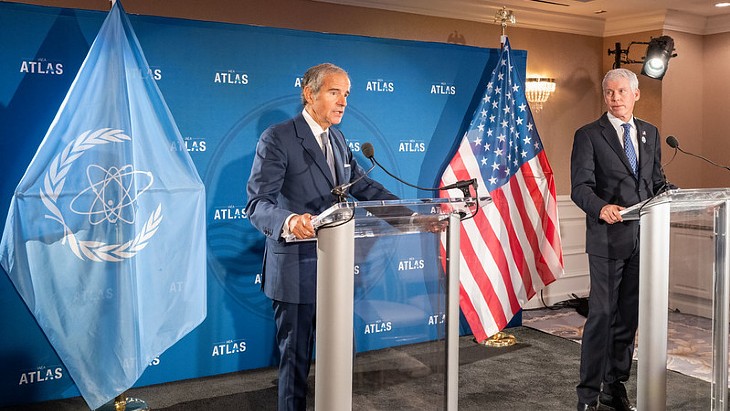
The joint statement was issued as the inaugural Atomic Technologies Licensed for Applications at Sea (ATLAS) meeting takes place in the USA.
The joint statement says: "Nuclear energy, in particular from advanced small modular reactors, has the potential to be a safe and viable option for maritime applications. For commercial shipping, this could pave the way for higher-speed maritime transport without the need for frequent refueling. At the same time, innovations such as floating nuclear power plants provide versatile energy sources that could deliver reliable electricity to coastal or remote communities and industry.
"As we look to the future, it is essential that the international nuclear and maritime communities collaborate to ensure the safe and secure deployment of these technologies, and to enhance the effective and efficient implementation of safeguards for civil nuclear applications at sea. Through ATLAS, the IAEA is bringing together a wide range of stakeholders - from Member States to industry - required to address these and other complex issues related to nuclear applications at sea."
The initial signatories to the statement are Argentina, Bangladesh, Belgium, Brazil, Canada, Denmark, the Dominican Republic, Finland, France, Greece, India, Italy, Japan, Malta, the Netherlands, Norway, Poland, Romania, Saudi Arabia, Singapore, Slovenia, South Korea, Turkey, the UAE, UK and USA.
The statement says that ATLAS will be technology-neutral, with "designs, business models, and operational concepts for these systems … largely still at an early stage" and "we look forward to the next stage of ATLAS, in which we will begin coordination and dialogue on key topics".
The IAEA describes ATLAS as the "first globally-coordinated effort to connect the nuclear and maritime sectors" and says that "advances in reactor design, fuel technology and maritime engineering mean some nuclear maritime designs could be ready for deployment as early as the 2030s. These technologies could power a wide range of uses: from large vessels such as container ships, bulk carriers, tankers, cruise ships, icebreakers and offshore support vessels, to providing reliable electricity, heat, desalination and emergency power for remote communities, ports, disaster response and offshore industries".
In his opening remarks, IAEA Director General Rafael Mariano Grossi said: "By bringing together the nuclear and maritime sectors, we have the opportunity to shape the future of two crucial industries - energy and shipping - and to build global confidence in the safe, secure and peaceful use of nuclear technology at sea."
He said that it was an "historic moment of opportunity" and the IAEA would "work to develop the institutional and regulatory parameters needed to ensure these technologies are safe, secure and safeguarded. No single country, entity or industry can do this alone. The IAEA is uniquely positioned to bring together regulators, governments, industry, technology developers and more".
The event, held in Washington DC, was co-hosted by the USA, with its Energy Secretary Chris Wright telling attendees that by "bringing governments, regulators, and industry together to tackle the practical barriers to deployment" the goal was to bring "us closer to turning the promise of offshore nuclear energy and nuclear-powered shipping into commercial reality".
Following the launch event, six project groups are being formed to "begin practical work this year to address the safety, security, safeguards and regulatory aspects, whilst taking account of deployment scenarios and other attributes of nuclear-powered shipping and floating nuclear power plants".


_51287.jpg)