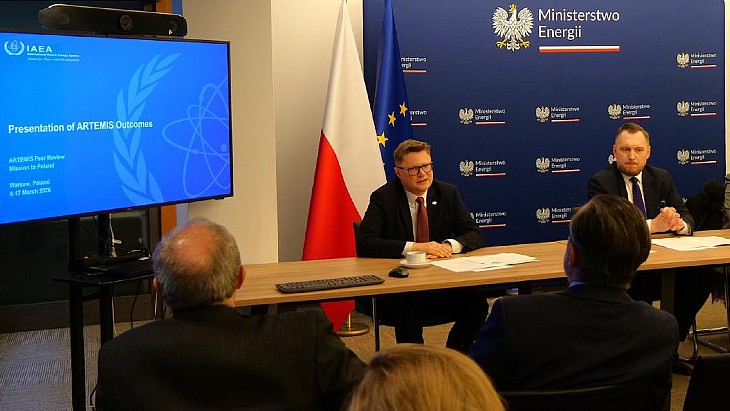
The 10-day Integrated Review Service for Radioactive Waste and Spent Fuel Management, Decommissioning and Remediation (ARTEMIS) mission to Poland took place from 8 March and was at the request of the Polish government.
The ARTEMIS team members - five experts in the safe management of radioactive waste and used nuclear fuel from Canada, France, Germany, Spain and Sweden, as well as IAEA staff members - concluded that "many aspects relevant to the safe management of radioactive waste and spent fuel in Poland are in place".
Poland does not currently have nuclear energy plants but uses nuclear and radiation technologies in medicine, industry and research and has the MARIA research reactor and the decommissioned EWA research reactor. Used fuel is stored in facilities located in Świerk. Since the early 1960s, Poland has operated the National Radioactive Waste Repository in the town of Różan, managed by the Radioactive Waste Management Plant (ZUOP).
The IAEA team’s recommendations and suggestions include: In the next update of the National Plan, the government should consider presenting a reference collection of assumptions for planning, resourcing and cost estimation relating to radioactive waste and used fuel management; the government should specify a clear timeframe for deciding whether to introduce very-low-level waste as an additional class of radioactive waste; and ZUOP should consider further developing the roadmap for establishment of the new near surface disposal facility intended to accommodate operational radioactive waste from nuclear power.
IAEA Deputy Director General Karine Herviou, Head of the Department of Nuclear Safety and Security, said: "Poland continues to set the pace in Europe for safe radioactive waste management, leading the way as the first EU Member State to host and now repeat an ARTEMIS peer review - clear proof of unwavering commitment to safety and trust in independent, international assessment."
Konrad Wojnarowski, Polish Vice Minister of the Ministry of Environment, said "Poland attaches great importance to maintaining the highest standards of safety, transparency and responsibility in the management of radioactive waste and used nuclear fuel, and such international peer review missions play an essential role in strengthening national systems and ensuring alignment with internationally recognised safety standards."
Aneta Korczyc, Director of ZUOP, said: "Meetings like these are extremely valuable because they enable open dialogue among international experts, the exchange of good practices, and the identification of areas where national solutions can be further strengthened. International expert reviews are an important element in building a transparent and resilient radioactive waste management system."
Poland is embarking on a nuclear power programme with the first nuclear power plant set to feature three Westinghouse AP1000 reactors, and a target operation date of 2036. There are also separate plans for at least one more gigawatt-scale plant and various small modular reactor projects being developed. In 2023, Poland announced plans to develop a new repository for short-lived low and intermediate level waste from the nuclear power programme as well as future institutional waste and retrieved historical waste from storage at Różan.


_55605.jpg)

_18654.jpg)