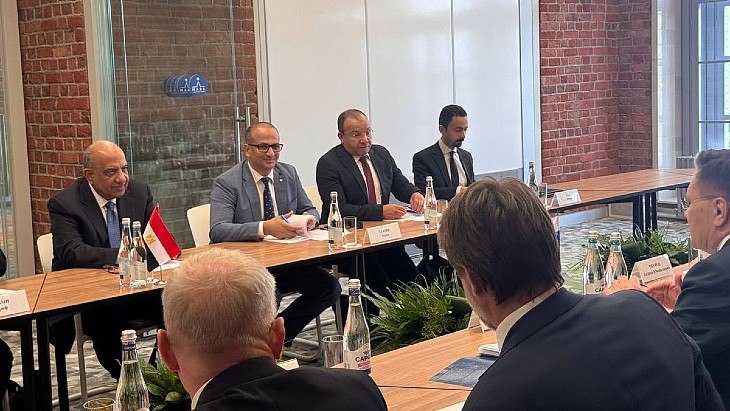
Alexei Likhachev, Director General of the Russian state nuclear corporation, met with Egypt's Minister of Electricity and Renewable Energy Mahmoud Esmat on Tuesday in Nizhny Novgorod, Russia, to discuss progress on the four-unit construction project.
According to Egypt's Nuclear Power Plants Authority: "The meeting addressed the latest developments in the implementation of the ... nuclear power plant project, reviewed the executive status of the work being carried out in the various components of the project, and the rates of completion, in addition to following up on the work programmes and targeted timetables for the implementation phases, and stressing the importance of continuing coordination between the Egyptian and Russian work teams, in order to ensure that the project is implemented according to the specified timetables, and in accordance with the highest standards of quality, safety and nuclear."
It added that the minister "held a meeting with the head of one of the companies affiliated with the Rosatom Corporation, which specialises in technologies and manufacturing of small nuclear reactor units. The meeting addressed the latest technological developments in this field, and discussed the possibilities of cooperation and benefiting from Russian expertise and technologies".
The minister also "emphasised Egypt's interest in following global developments in the field of small nuclear reactor technologies, and studying the possibilities of benefiting from them in the future, in light of the state's strategy to diversify energy sources and maximise the benefit from nuclear technology in peaceful uses, while conducting the necessary technical and economic studies, and taking into account all nuclear safety and security requirements".
According to Russia's state-owned Tass news agency, Likhachev said the talks had seen the start of "discussions around the second phase of the potential expansion of the [El Dabaa] plant by two more units" and also the "financial and economic model for the fifth and sixth units. If we reach a consensus and shared understanding, we will report to the leadership of our countries".
He also said that delivery of nuclear fuel for the first power unit is scheduled for 2027 ahead of it being connected to the grid in 2028.
As well as potential new units at El Dabaa and small modular reactor options, the two sides also discussed cooperation in the construction of a water desalination plant and the establishment of nuclear medicine and additive manufacturing centres.
Background
El Dabaa will be Egypt's first nuclear power plant, and the first in Africa since South Africa's Koeberg was built nearly 40 years ago. The Rosatom-led project, about 320 kilometres north-west of Cairo, will comprise four VVER-1200 units, like those already in operation at the Leningrad and Novovoronezh nuclear power plants in Russia, and the Ostrovets plant in Belarus.
Under the 2017 contracts, Rosatom will not only build the plant, but will also supply Russian nuclear fuel for its entire life cycle, including building a storage facility and supplying containers for storing used nuclear fuel. It will also assist Egyptian partners in training personnel and plant maintenance for the first 10 years of its operation. Rosatom has said it is aiming for a future service life of up to 100 years for nuclear power plants.
The four units are being built almost concurrently, with first concrete at unit 1 in July 2022, followed in turn by the others, concluding with first concrete at unit 4 in January 2024. Egypt's aim is for 9% of electricity to be generated by nuclear by 2030, which would be achieved by the commercial operation of the first two units by that time, directly displacing oil and gas.


_51287.jpg)