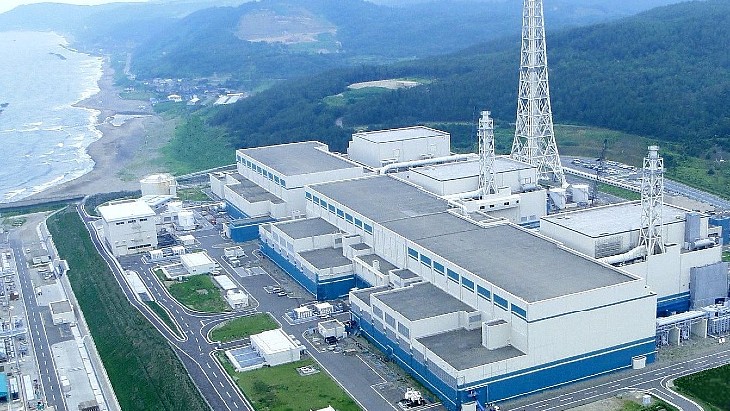
"We are currently adjusting personnel and confirming prior arrangements, and plan to start up the reactor on 9 February," Takeyuki Inagaki, head of the Kashiwazaki-Kariwa plant, told a press conference on Friday.
Tokyo Electric Power Company (Tepco) restarted the reactor in the evening of 21 January. However, shortly after midnight on 22 January, "an alarm was triggered in the control rod operation monitoring system for one control rod during the control rod withdrawal operation, causing the withdrawal operation to be suspended". The unit's restart was subsequently suspended while an investigation into the cause of the alarm was carried out.
"As a result of various tests conducted at the plant and elsewhere, we have confirmed that, in rare cases, one of the three electrical wires supplying electricity to the motor experienced a delay in the rise of current when the motor was started," Inagaki said. "Although this delay was within the normal range of operation of the equipment, we determined that the inverter had detected the delay as an abnormality. The inverter detection function was added to the new inverter when the equipment was upgraded in 2023.
"Since a separate function to shut down the inverter for equipment protection was originally included, this function was added with the aim of making it easier to identify the cause when a malfunction occurred. However, in light of this incident, and as this function is not necessary for safety, we have set all control rod drive mechanism inverters to not detect the fault. We are then operating each control rod drive mechanism one by one to confirm that there are no problems.
"However, because simultaneous withdrawal of multiple control rods can only be confirmed during reactor startup operations, we intend to conduct checks to ensure there are no problems when starting the motors during reactor startup operations."
Inagaki said that if any malfunctions are discovered during startup operations, "all relevant parties will thoroughly investigate and proceed carefully, one step at a time".
Tepco said it plans to raise the pressure inside the reactor gradually after restarting it, and resume power generation and transmission on 16 February. It will then halt the reactor temporarily on 20 February or later to check for abnormalities, before conducting a final inspection and confirmation from the Nuclear Regulation Authority. The unit is now scheduled to return to commercial operation on 18 March.
The seven-unit Kashiwazaki-Kariwa plant was unaffected by the March 2011 earthquake and tsunami which damaged Tepco's Fukushima Daiichi plant, although the plant's reactors were previously all offline for up to three years following the 2007 Niigata-Chuetsu earthquake, which caused damage to the site but did not damage the reactors themselves. While the units were offline, work was carried out to improve the plant's earthquake resistance. All units have remained offline since the Fukushima Daiichi accident.
Although it has worked on the other units at the Kashiwazaki-Kariwa site, Tepco is concentrating its resources on units 6 and 7 while it deals with the clean-up at Fukushima Daiichi. These 1356 MWe Advanced Boiling Water Reactors began commercial operation in 1996 and 1997, respectively, and were the first Japanese boiling water reactors to be put forward for restart. Tepco received permission from the Nuclear Regulation Authority to restart units 6 and 7 in December 2017. Restarting those two Kashiwazaki-Kariwa units - which have been offline for periodic inspections since March 2012 and August 2011, respectively - would increase the company's earnings by an estimated JPY100 billion (USD633 million) per year.
The governor of Japan's Niigata Prefecture, Hideyo Hanazumi, gave his approval for the restart of Kashiwazaki-Kariwa units 6 and 7 in November last year, with the Prefectural Assembly backing his decision in December.
Tepco is prioritising restarting Kashiwazaki-Kariwa unit 6, where fuel loading was completed in June last year. The company has until September 2029 to implement anti-terrorism safety measures at unit 6. Kashiwazaki-Kariwa 6 would become the first reactor owned by Tepco to restart following the Fukushima Daiichi accident.


_1_12560.jpg)
_55462.jpg)


_84289_33276.jpg)