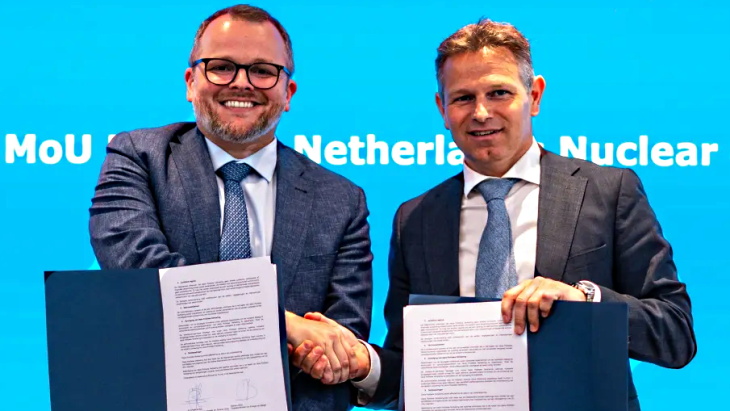
The MoU was signed by Belgium's Federal Minister of Energy Mathieu Bihet and Dutch State Secretary for Climate and Green Growth Jo-Annes de Bat during the BeNeNuc Summit (Belgian-Dutch Nuclear Summit).
The MoU stipulates that the Netherlands and Belgium will work on a broader research & development base and intensify knowledge exchange. To this end, both countries will meet periodically. In this way, the Netherlands can benefit from the existing industrial knowledge and applications currently available in Belgium due to the larger number of operational nuclear power plants. Conversely, the Netherlands can share knowledge gained regarding the construction of new nuclear power plants and developments concerning small modular nuclear reactors (SMRs). For example, in the areas of site research, permitting, processes, and components for nuclear power plants.
Moreover, the Netherlands and Belgium want companies and knowledge organisations in the nuclear energy chain and supply chain to find and strengthen each other more effectively. Therefore, the two countries are setting up innovation missions between companies and knowledge organisations active in the Netherlands and Belgium. Where possible, the governments will encourage cooperation between companies.
In addition, two countries want to commit to strengthening the knowledge and skills of people who will work in the nuclear sector. During the peak of the construction of the nuclear power plants, this involves 10,000 employees, and on average over the entire construction process, about 5,000 employees. This can be achieved, for example, through joint training programmes.
The two countries also commit to working together on solutions regarding the management, storage, and eventual disposal of radioactive waste.
"Future European nuclear projects require strong value chains, high-level expertise, and close cooperation between states, research centres, and industry," Bihet said. "Belgium and the Netherlands possess recognised expertise and wish to join forces today to contribute to the development of a more robust, innovative, and independent European nuclear ecosystem."
"The Netherlands is currently at a crucial point, with plans to become more energy independent through increased nuclear energy in the energy mix," de Bat added. "In a sector currently brimming with developments and benefitting from a high density of knowledge, cooperation with neighbouring countries is essential. With Belgium, we can give our mutual ambitions the necessary boost. In doing so, we strengthen the sector and also contribute to broader European development."
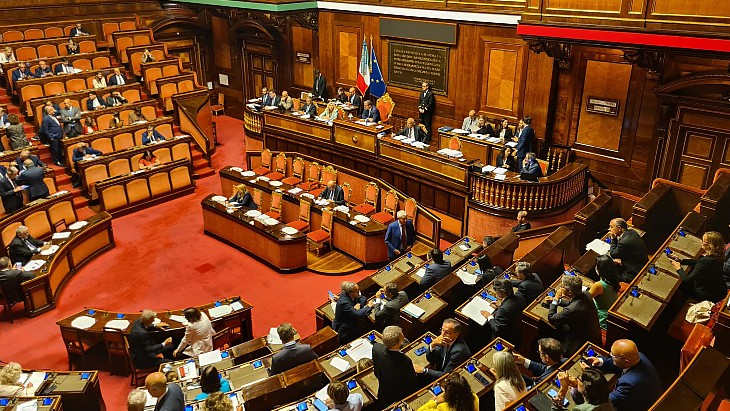
In May last year, Belgium's federal parliament voted by a large majority to repeal a 2003 law to phase-out of nuclear power and ban the construction of new nuclear generating capacity. Under the phase-out policy, unit 1 of the Tihange plant was set to shut in October this year, with Doel 2 following in December. Belgium's last two reactors - Doel 4 and Tihange 3 - were scheduled to close in November 2025, but a final agreement was reached in December for the two units to continue operating for a further 10 years.
In late April, the Belgian government announced it had begun talks to take direct ownership of the country's seven nuclear power reactors - with all decommissioning and dismantling works suspended "to ensure that all options remain available to the Belgian State".
In December 2021, the Netherlands' new coalition government placed nuclear power at the heart of its climate and energy policy. In addition to keeping the Borssele plant in operation for longer, the government also called for the construction of new reactors. Based on preliminary plans, two new reactors will be completed around 2035, and each will have a capacity of 1000-1650 MWe. The government is also taking steps to prepare the Netherlands for the possible deployment of SMRs.


_76412.jpg)
_38809.jpg)
_15774.jpg)