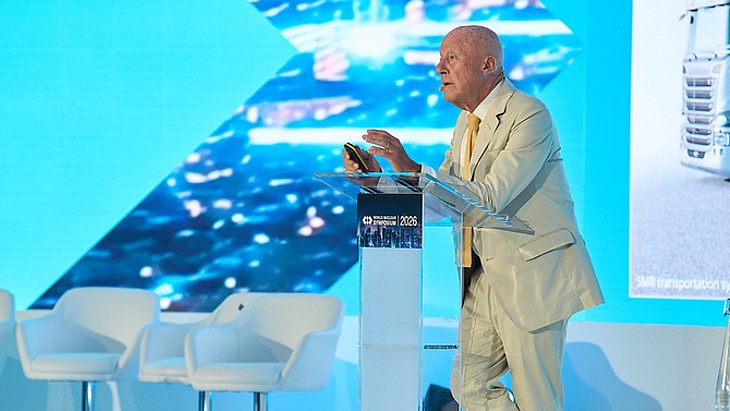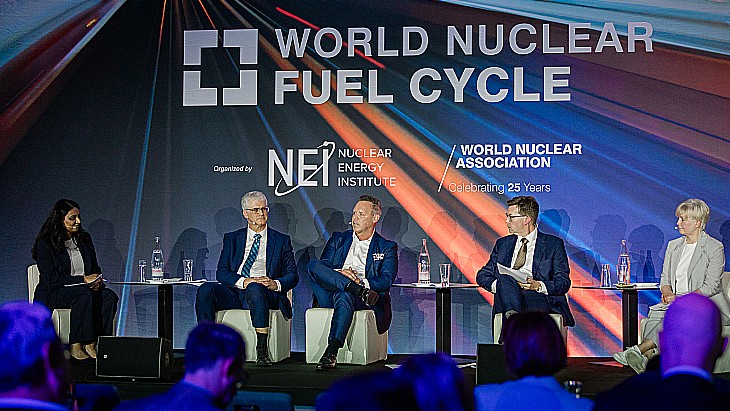
The first panel of the two-day conference saw industry leaders set the scene, outlining accelerating plans for new nuclear deployment from countries with long-established nuclear programmes to newcomer countries and new applications such as maritime propulsion.
Johnathan Chavers, Director of Nuclear Fuel and Analysis, Southern Nuclear, described the growth opportunities presented by increasing electricity demand - both from large load customers such as manufacturing and data centres, as well as residential customers - as unprecedented and transformational. Southern Company is itself investing USD81 billion in energy infrastructure through 2030 to support this growth - and in nuclear, it is focusing on the existing installed capacity, he said, "because that's how we can respond the quickest. But we need to do what is necessary today to prepare ourself and preserve the option to grow nuclear",
The vital role of existing capacity was highlighted by speakers across the conference. Japan shut down its nuclear fleet following the Fukushima accident of 2011. It has now restarted 15 of its fleet of 36 reactors, Shuji Yoneda, General Manager of the Federation of Electric Power Companies of Japan's Washington DC Office, said, with more restarts to come. But for the first time in 20 years, the Japanese government is projecting increases in electricity demand and envisages nuclear providing 20% of its electricity generation mix by 2040. As well as accelerating the restart process and extending the operating lifetime of those 36 plants, Japan will also need some 5.5 GWe of new nuclear capacity to reach that goal.
Whether from existing capacity, new-build, or new applications, the entire value chain is central to sustained global nuclear growth, said Christian Di Lizia, EDF Senior Business Developer Relations with International Organisations. Standardisation and replication of projects not only leads to speed, cost and quality improvements - they also attract finance. "Very often when we talk about financing projects, there's a kind of a tendency of thinking about reactor technology. It goes beyond that," he said.
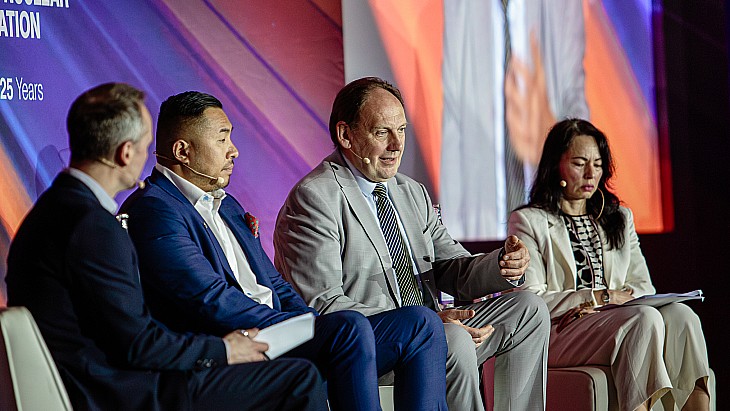
Istvan Szabo (second from right) (Image: World Nuclear Association)
Istvan Szabo, Senior Sector Engineer at the European Investment Bank, highlighted the importance of regulatory frameworks and capital flow to propel the sector forward - whether for building new capacity or keeping supply chains open. The bank is the long-term lending institution of the European Union, and has a track record of financing nuclear-related projects dating back to the 1970s. "If there is a credible and clear policy, and the project fundamentals are in place, then the experience shows that even long-term financing, both public and private, is available," he said.
Uranium fundamentals
There is no shortage of uranium ore to fuel a growing nuclear sector, but for mining companies to be ready to meet this demand, exploration is a "must", Louis-Pierre Gagnon, Orano Canada's Director of Mining, said in the panel on A Deep Dive into Uranium Mining and Supply. As well as through its well-balanced and diversified pipeline of existing projects in Mongolia - where commissioning of the Zuuvch Ovoo uranium mine is expected to begin in 2028 - Uzbekistan, Canada, and Namibia, Orano is working to secure future supplies through exploration in those jurisdictions and also in new areas in Australia and Botswana, Gagnon said. And innovation in mining - such as Orano's SABRE (Surface Access Borehole Resource Extraction) technique, already in use in Canada, will also play a part in securing future supplies.
Another mine looking set to come into operation is Bannerman Resources' Etango project in Namibia. A key milestone for Bannerman has been the recently announced strategic partnership with CNNC Overseas Limited, the company's VP Market Strategy Olga Skorlyakova said, providing a "pathway to funding" and allowing the project to move forwards into construction: an early works programme is already under way, and with a final investment decision - followed by the start of full-scale construction - expected in the second half of this year, first production is targeted in 2028.
Uranium producers rely on financing to be in place before they can proceed with new projects. Robert Willette, CEO of US-based in-situ recovery uranium producer enCore Energy Corp, said policymakers and regulators - as well as the market - have a part to play here. "Obviously, demand is there, and the resources are there. The real question comes down to a problem of capital formation. And what I mean by that is we have active engagement from utilities and other end users. The difficulty is that those discussions are oftentimes anchored in current market prices. And it's very difficult to have those when you're talking about long-term developed projects that really don't align with current market pricing," he said.
This leads to a disconnect, where a company has to make long-term capital decisions "without having real visibility into what that future market's going to look like", he said. "Supply is not based upon current markets. Supply really responds to confidence in future markets and what that looks like."
Aligning end user contracting, permitting certainty, and policy support will bring the confidence that is needed to bring projects forward, he said. " I think when you get those aligned, you will see capital deployed," he said.
Working together for the future
The two-day programme culminated in a final session when industry leaders were asked to distil the core themes of the conference into an actionable framework, aligning the entire value chain toward the singular goal of a successful, scalable, and sustainable energy transition.
"I can't believe how good things are for all sectors of our industry," John Donelson, Senior VP and CMO at Centrus Energy, said in the final panel of the event in Monaco. "But eventually, all the good words that we have need to be turned into action. So I think the consensus is that we need to execute … it's executing all the programmes that we have in play."
Jonathan Hinze, President of UxC, LLC, agreed with Donelson's assessment of the positivity within the nuclear industry, but despite a general consensus, he said: "I think when we look at our nuclear fuel markets, we're seeing a little bit of variation of opinion - which is always normal in this industry, as it should be.
"I think what I've sensed in this event, speaking to a lot of both utilities and suppliers and others, is that they're trying to find common ground at the same time as being aware of the kind of positions in the market … and I think what I'm noticing is that while there are differences of opinion, we all are sort of still going in the same direction, and that's really important."
Maureen Zawalick is Senior Vice President and Chief Risk Officer at PG&E Corporation. PG&E's Diablo Canyon - which provides nearly 9% of California's electricity and 17% of its zero-carbon energy - had been slated for retirement in 2024-2025 until the state passed a law allowing the two units to continue operation until 2030. Keeping the plant operating - and looking to secure the state-level legislative action to enable operation beyond 2030 - needs collaboration and cooperation, she said.
"The demand growth that we're seeing is going to necessitate us moving into a direction of changing how we've purchased and procured previously," she said. "So there's a lot of variables, it's almost like a Venn diagram that all has to come together to where we go forward in this area. So cooperation and collaboration is key."
World Nuclear Fuel Cycle 2026, held in Monaco in April, was co-organised by the Nuclear Energy Institute and World Nuclear Association.


_42437.jpg)
_76412.jpg)